
Do Cities Need Crash-Rated Barriers?
Article Summary
Crash-rated barriers are not an all-or-nothing decision for cities. This article gives you a practical checklist to decide where crash-rated barriers make sense, how Delta’s S Barrier fits alongside other portable systems, and how to build internal buy-in using clear, risk-based talking points.
Ask A Better Question
Discussions about vehicle barriers inside city government can polarize quickly. Some voices say that cones, trucks, and police presence are enough. Others argue that every public gathering should be treated like a high-risk summit.
A better approach is to ask a more specific question: which streets, events, and public spaces in the city justify crash-rated protection, and what type of system fits those locations? Framing the question this way shifts the conversation from an all-or-nothing choice to a targeted, risk-based discussion.
Agencies such as CISA provide guidance on vehicle incident prevention and mitigation that can support this process. Their Vehicle Incident Prevention and Mitigation Security Guide is available at: https://www.cisa.gov/resources-tools/resources/vehicle-incident-prevention-and-mitigation-security-guide
Vehicle Incident Prevention And Mitigation Security Guide
Where Crash-Rated Barriers Often Make Sense
If you look at a full year of city events and street activity, certain patterns emerge. Crash-rated barriers tend to be easier to justify where crowds are dense and remain in place for long periods, vehicles can build and maintain speed on the approach, the same locations host recurring events, and the space carries symbolic or civic importance.
Examples include main parade corridors, central plazas used for major celebrations, entry routes to stadiums or arenas, and streets in front of civic buildings.
In contrast, a small fun run on a low-speed neighborhood street may not need more than traditional traffic control and police support. The goal is to identify a small set of locations where a vehicle intrusion would be both plausible and especially damaging.
How The S Barrier Fits In Delta’s Lineup
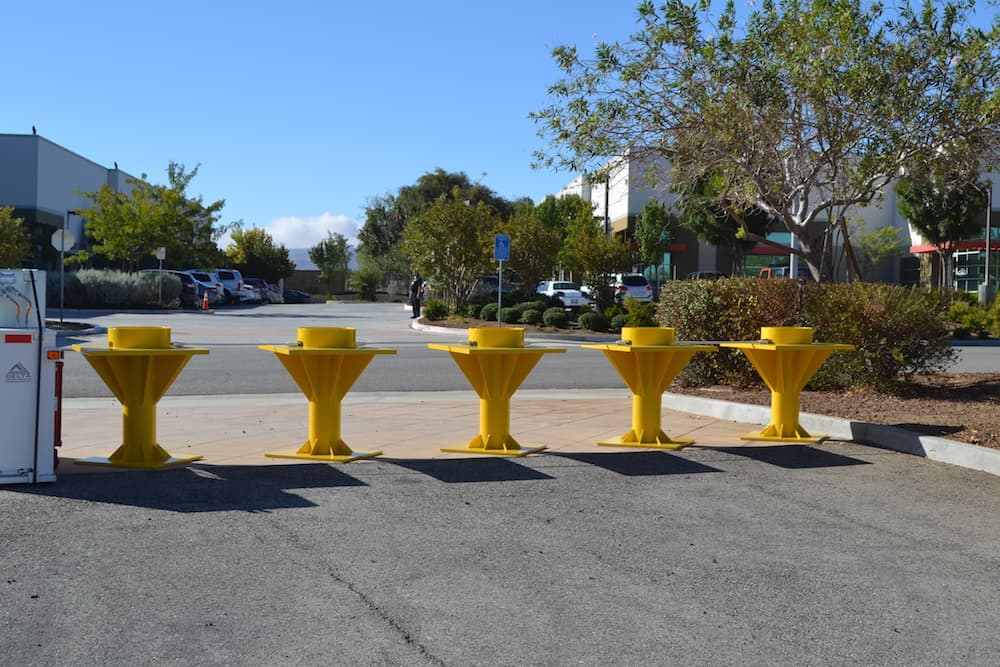
Delta offers several crash-rated systems that can be used individually or together in a city plan. For portable solutions, there are barriers such as the MP5000 Portable Barrier, the MP100 Portable Barrier, the TB100 Portable Bollard System, and the S Barrier. An overview is available at: https://deltascientific.com/high-security-portable-barriers/
High-Security Barricades & Bollards For Immediate Protection
These systems share a focus on crash testing and documented performance but serve different roles.
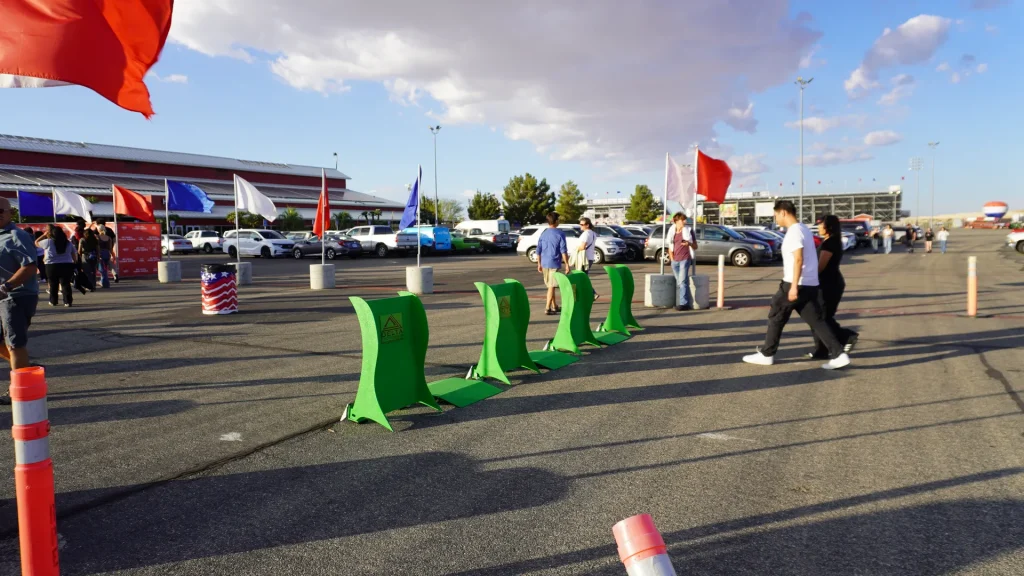
The S Barrier is often a good fit when the relevant threat profile can be addressed with an SC-level barrier, permanent construction is not possible or not acceptable to the community, city leaders want a barrier that reads as civic infrastructure instead of heavy equipment, and the same streets host repeating events that make reuse likely.
You are not choosing between the S Barrier and all other measures. You are choosing where it belongs within a larger mix that includes other barriers, bollards, traffic control, and staffing.
A Readiness Checklist For Cities
The following checklist can help teams decide whether a crash-rated barrier program is worth serious consideration.
Events And Crowds
Streets And Speed
Current Measures
Operations And Storage
If many of these statements are true, it is reasonable to explore a limited program focused on a small number of priority locations.
Talking With Finance, Leadership, And The Public

Even when technical teams agree on the need, the investment still has to be justified to others. Finance, leadership, and the public will each have different concerns.
Cost And Justification
Where possible, tie the investment to existing risk management or continuity plans rather than treating it as a standalone project.
Public Perception And Optics
Residents often respond better when barriers are presented as part of a thoughtful, long-term approach to safe public spaces.
Moving From Interest To Action
If a city decides that at least one corridor or public space justifies a crash-rated barrier, the next steps are practical.
Pilot deployments can also inform capital planning by providing real data on labor, storage, and coordination needs.
Conclusion And Next Steps
Crash-rated barriers are no longer limited to embassies and high-security campuses. Portable systems such as the S Barrier make it possible for cities of many sizes to bring tested vehicle protection to selected streets and public spaces without rebuilding their entire network.
If you see a gap between your current event or streetscape plans and the expectations of your community, a conversation with Delta is a low-risk starting point. Through the Request a Quote form or the Contact page, you can share information about your streets and events and explore whether a focused crash-rated barrier program makes sense for your city.
Recent Posts




Frequently Asked Questions
Delta Scientific
Delta Scientific Corporation is the world’s leading manufacturer of vehicle access control equipment. Delta Scientific has been engineering and manufacturing vehicle access control equipment and selling its products worldwide since 1974.