
Vehicle Barriers for Stadium Security: Securing Plazas, Player Access, and Loading Docks
Article Summary
Stadium security is not one barrier problem. A modern venue has pedestrian plazas, controlled vehicle lanes, team and crew entries, and service areas that each need a different level of access control and crash protection. The best plans usually combine passive barriers, active entry-point barriers, and portable overlays. That approach helps stadium operators protect crowds, preserve traffic flow, and keep event-day operations moving
What Stadium Security Perimeters Actually Need
A stadium perimeter is rarely one continuous condition. On the same site, you may have an open pedestrian plaza, a rideshare or VIP drop-off edge, a credentialed team entrance, and a loading dock that must handle delivery trucks. Treating all of those zones the same usually creates either too much friction for operations or too little protection where it matters most.
That is why stadium planning works better when the barrier strategy follows the lane type. Delta’s stadium security and public spaces security pages show the same pattern: permanent pedestrian edges, temporary event overlays, and active high-security barriers each solve a different problem. CISA makes a similar point in its Vehicle Incident Prevention and Mitigation Security Guide, which says vehicle mitigation must be tailored to the physical constraints and functional demands of each site.
How Fixed Bollards Fit Pedestrian Plazas and Walk-Up Edges
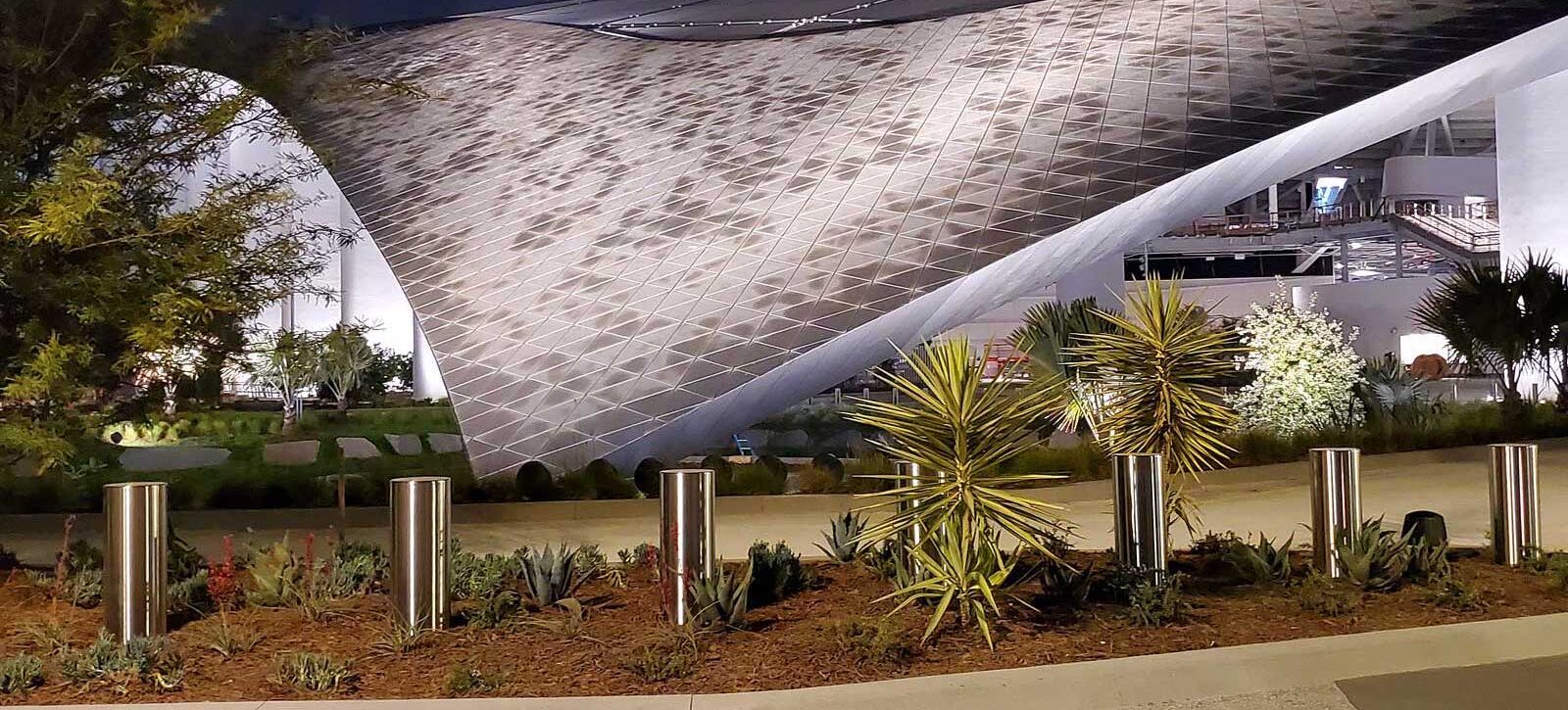
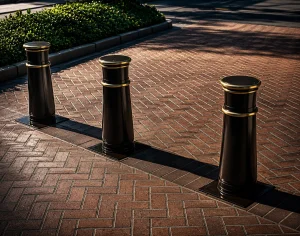
Fixed bollards are usually the cleanest answer for the parts of a stadium that should stay vehicle-free every day. That includes front plazas, ticketing approaches, concourse edges, sidewalk transitions, and any point where large pedestrian volumes meet a possible vehicle path. In those locations, the barrier should be present at all times, with no operator action required.
Delta’s high-security bollards line includes shallow-foundation and crash-rated options suited to permanent perimeter work. Products such as the DSC600 fixed bollard module, DSC633, and DSC635 help designers protect pedestrian space where utilities, slab depth, or retrofit limits can make deep foundations difficult.
For stadium projects, bollards do two jobs at once. First, they create passive hostile vehicle mitigation at the edge of a plaza. Second, they define the pedestrian realm in a way that still feels open and intuitive on a busy game day. That matters because a barrier line that protects the crowd but confuses circulation can create a different operational problem.
From a standards standpoint, ASTM F2656 is the key reference when the concern is a higher-speed hostile vehicle threat at a perimeter. ASTM F3016 can also be relevant in lower-speed zones where the concern is more about shorter approach distances or lower-speed impact conditions. The correct standard depends on the threat model, approach path, and the specific point being protected, not just the venue type.
Where Portable Barriers Make Sense for VIP Drop-Off and Event-Day Changes

Portable barriers are valuable because stadium operations change by event, season, and threat posture. A concert may need a larger protected footprint than a weekday tour. A playoff game may add screening and standoff at a rideshare curb. A special event outside the main gate may need a temporary vehicle exclusion zone that is not part of the daily layout.
That is where portable vehicle barriers become useful. Delta’s MP100 is certified M30/P3 in a five-unit array and can be deployed on existing concrete, asphalt, or hard-compacted surfaces without excavation. The MP5000 adds towable rapid deployment across 12-, 16-, and 20-foot clear openings, which is useful when a stadium needs to close a wider service lane for an event overlay. The TB150 portable bollard provides an M50/P3-rated portable option for temporary venue protection.
Portable barriers should not replace permanent site planning where a fixed solution is appropriate. They are best used as a layer on top of the base design. In stadium work, that often means protecting a VIP queue during arrivals, expanding a pedestrian plaza into an adjacent lane on event day, or creating a temporary sterile area around a team entrance or media compound.
CISA’s vehicle-ramming self-assessment guidance also points operators toward separating pick-up and drop-off activity from pedestrian entrances where possible, limiting the number of vehicle-sized openings, and preserving emergency vehicle ingress. Portable systems are often the most practical way to support that temporary reconfiguration.
Why Wedge Barricades Belong at Team, Crew, and Service Vehicle Entries
Some stadium lanes cannot be closed permanently because authorized vehicles still need access. Team buses, broadcast trucks, catering, maintenance, and emergency responders all require controlled entry points. Those lanes call for an active barrier that stays low for authorized movement and rises fast when the lane must be secured.
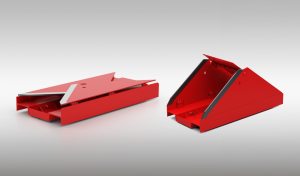
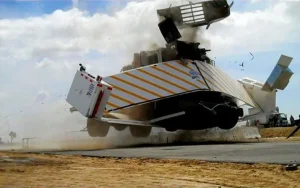
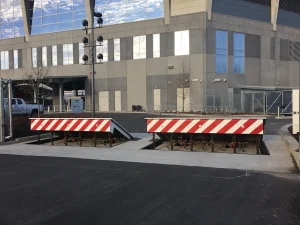
That is the core use case for wedge barricades. Delta notes that wedge systems are commonly chosen for high-risk entries because they combine high crash ratings with operation rates in the 0.5 to 1.5 second range. A model such as the DSC207S brings an M50/P1 rating, a shallow enclosed design, and a relatively small footprint that can work well at controlled stadium lanes.
At a player or crew entrance, a wedge barrier can be integrated with a guard booth, credential check, gate arm, camera system, or fencing line. At a loading dock or back-of-house service road, it can create a true active stopping point instead of relying on cones, chains, or a conventional parking gate that was never designed for crash performance.
This is also where roadway disturbance matters. Wedge barriers do require civil coordination, drainage planning, and controls integration, but that tradeoff is often worth it at the few lanes where the venue needs both throughput and real active protection.
How to Map Barrier Types to Common Stadium Zones
A useful way to simplify early planning is to match the barrier family to the lane condition instead of starting with one product and trying to force it everywhere.
| Stadium Zone | Primary Need | Best-Fit Barrier | Why It Fits |
| Front plaza and ticketing edge | Passive protection with constant pedestrian flow | Fixed crash-rated bollards | Always present, visually predictable, minimal day-to-day operation |
| VIP curb, rideshare edge, event overlay | Temporary perimeter changes | Portable barriers or portable bollards | Fast deployment without excavation, useful when layouts change by event |
| Team, crew, and media vehicle lane | Controlled authorized entry | Wedge barricade | Fast raise/lower cycle with real stopping capability at an active lane |
| Loading dock and service road | Truck access plus high consequence if breached | Wedge barricade, sometimes backed by bollards or fencing | Creates a hardened vehicle checkpoint at the highest-risk service entries |
Most stadiums end up with a mix, not a single product family. That is normal. The goal is not to make every edge look the same. The goal is to make each edge perform the way the venue actually operates.
Standards and Planning Points Inspectors Will Ask About
Inspectors, designers, and owners will usually focus on four issues early: crash rating, approach conditions, foundation constraints, and emergency operations. A product rating matters, but so do the real site conditions around that product. Approach distance, lane width, utility conflicts, drainage, pavement build-up, and adjacent fencing all affect how a barrier system should be specified and installed.
ASTM says F2656 provides the impact conditions, designations, and penetration levels used to select barriers for sites with a defined moving vehicle threat. ASTM F3016 addresses low-speed vehicle impact protective devices and is useful when the hazard profile is different from a high-speed anti-ram perimeter condition.
In practice, that means a stadium should document which entries are pedestrian-only, which lanes remain active, which roads can be closed on event day, and how emergency vehicles will still get through. Barrier selection gets much easier once those operational rules are clear.
Build One Stadium Plan, Not Three Product Lists

The strongest stadium barrier programs do not treat bollards, portables, and wedges as competing answers. They treat them as layers. Fixed bollards protect the places that should never accept vehicle access. Portable systems let operators change posture by event. Wedge barricades secure the few controlled lanes where authorized vehicles still have to move.
Delta’s stadium security solutions and broader high-security barricade portfolio support that layered approach across permanent and temporary entry conditions. For a stadium project, that is usually the right question to ask first: which edges need to stay open, which need to stay closed, and which need to change by event?
If you are planning new construction, a retrofit, or an event overlay, start by mapping each stadium zone to the way vehicles and pedestrians actually use it. Then match the barrier type to that operational reality, not the other way around.
Improve Stadium Security with Vehicle Barrier Planning from Delta Scientific
A stadium security plan works best when permanent and temporary barriers are chosen as one integrated system. Contact Delta Scientific to discuss fixed bollards, portable barriers, and wedge barricades for your venue, or request a quote for project-specific recommendations.
Recent Posts

Frequently Asked Questions
Keith Bobrosky
Keith Bobrosky is President of Delta Scientific. A former applications engineer, he writes and speaks to the practical side of vehicle security, connecting crash ratings and standards to what works on real sites.