
Electromechanical vs. Hydraulic Barriers: The Question I Get Asked Most
Article Summary
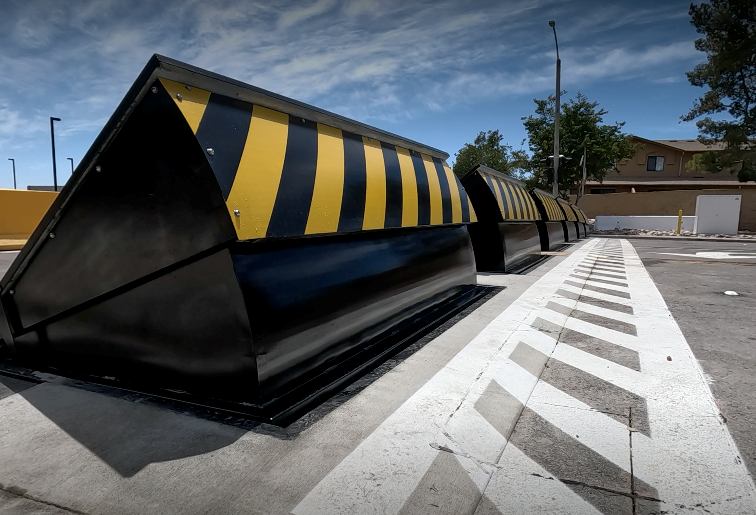
Electromechanical or hydraulic—which barrier system is right for your facility? In this article, Delta Scientific President Keith Bobrosky explains the key differences between the two technologies, breaking down the advantages, limitations, and ideal applications for each. Rather than declaring one option universally better, the article emphasizes selecting the right system based on your site’s operational needs, maintenance requirements, power availability, and long-term performance goals.
Electromechanical vs. Hydraulic Barriers: The Question I Get Asked Most
If you’ve spent any time around vehicle barriers, you’ve probably heard the debate.
Electromechanical or hydraulic?
It’s one of the most common questions I get from consultants, architects, security professionals, and facility owners. Usually, the question comes with an assumption already built in.
Electromechanical is newer technology. Therefore, it must be better.
I understand why people think that. We tend to associate newer technology with progress. Sometimes that’s true. Sometimes it’s not that simple.
Before I tell you where I stand, it’s worth looking at the strengths and weaknesses of both.
At Delta Scientific, we manufacture and support both hydraulic and electromechanical vehicle barriers. We work with customers who specify each technology for different reasons, and we’ve seen successful installations of both around the world. That perspective has given us a front-row seat to the advantages, limitations, and long-term realities of each approach.
Hydraulic barriers have been the industry standard for decades. There is a reason for that.
Hydraulic systems are incredibly robust. They generate tremendous force, operate reliably in harsh environments, and have a long track record in high-security applications.
Think about the heavy equipment you see on construction sites. Excavators. Backhoes. Bulldozers. Graders.
They’re hydraulic.
Those machines work in mud, rain, snow, heat, and dust. They deliver enormous amounts of power day after day. When people need dependable force, hydraulics have historically been the answer.
Hydraulic vehicle barriers share many of those same characteristics. They are durable, straightforward, and relatively easy to troubleshoot. Most hydraulic components are widely available, and many repairs can be performed with standard tools by technicians who understand hydraulic systems.
That simplicity matters more than people realize.
Electromechanical barriers bring a different set of advantages.
They are typically quieter. They eliminate hydraulic fluid. They can be attractive in environments where owners have concerns about oil, contamination, or environmental regulations.
For some projects, those factors are important enough to drive the entire specification.
Electromechanical systems have also become increasingly sophisticated over the past decade. The technology continues to improve, and there are applications where they make sense.
What I find interesting is how people think about maintenance.
Many assume that because an electromechanical barrier doesn’t use hydraulic fluid, it somehow doesn’t require maintenance.
That is simply not true.
I think of it the same way I think about the difference between a Tesla and a traditional internal combustion engine vehicle.
A lot of people assume the Tesla is maintenance-free because it doesn’t need oil changes. What actually happens is that the maintenance changes.
With a traditional vehicle, you call a mechanic. Someone who understands engines, pumps, belts, hoses, and mechanical systems. They know how things work because they’ve worked on them their entire career.
With a Tesla, you call a technician. Somebody with a laptop. Somebody who can connect to the system, interpret fault codes, diagnose software issues, and work through a much more technology-focused troubleshooting process.
Both require maintenance, it’s just a different set of skills.
The same principle applies to vehicle barriers.
Hydraulic systems are generally more mechanical in nature. Electromechanical systems often require a higher level of technical expertise, programming knowledge, and electronic diagnostics. When something goes wrong, the solution may involve a laptop as much as a wrench.
That doesn’t make one better than the other. It just means owners should understand what they’re buying and who will be maintaining it five or ten years from now.
Another factor worth considering is serviceability.
If a hydraulic component fails at a remote site, there is a good chance replacement parts can be sourced locally or repaired using readily available parts. Electromechanical systems often rely on more specialized parts, proprietary electronics, and technicians with specific expertise.
For some customers, that difference matters. For others, it doesn’t.
Every project has its own priorities.
My personal opinion is that there is a place for both technologies.
We offer both because there are legitimate applications for both. Some projects are driven by environmental requirements. Some are driven by maintenance requirements. Some are driven by customer preferences or site-specific constraints.
If a specification requires a no-oil solution, electromechanical systems can be an excellent choice.
But when the conversation turns to raw reliability and dependable power, I still favor hydraulics.
There is a reason you don’t see fleets of electric bulldozers dominating construction sites. There is a reason excavators, graders, and other heavy equipment continue to rely on hydraulic power.
When the job demands force, durability, and proven performance in difficult conditions, hydraulics continue to earn their reputation.
Vehicle barriers are no different.
Unless a project specifically requires a no-oil solution, I generally believe hydraulic systems remain the best choice for high-security vehicle barriers.
That’s the conclusion I’ve reached after decades of watching both technologies perform in the field. Then again, Ferrari just launched an electric vehicle, so maybe ask me again in ten years.
Recent Posts




Frequently Asked Questions
Keith Bobrosky
Keith Bobrosky is President of Delta Scientific. A former applications engineer, he writes and speaks to the practical side of vehicle security, connecting crash ratings and standards to what works on real sites.