
Bollards for Storefront Protection: Designing Against Vehicle-Into-Building Crashes

Why Storefront Bollards Are a Different Design Problem
When a vehicle hits a storefront, the question is not just whether a bollard was present. The real question is whether the bollard system matched the actual approach conditions of the site. A parking lot in front of a strip retail building creates one type of exposure. A main street storefront beside a fast urban corridor creates another.
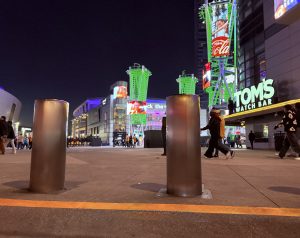
That is why bollards for storefront protection should be specified as part of a site plan, not treated like a generic streetscape accessory. The barrier has to protect people inside and outside the building, preserve pedestrian flow, and work with the storefront&rsquo,s visibility and brand presentation.
Low-Speed vs High-Speed Threats at Storefronts
Many vehicle-into-building crashes at retail sites are low-speed events. ASTM says ASTM F3016 provides a test method for vehicle protective devices subjected to low-speed vehicle impact, which is why it is often part of the conversation for storefronts, parking lots, and pedestrian-facing commercial spaces.
That does not mean every storefront problem is a low-speed problem. If the building sits on a direct approach from a public street, a downhill drive, a long curb lane, or a site with known hostile vehicle concerns, teams may need to step up to ASTM F2656 crash-rated barriers . ASTM F2656 is the standard Delta and other high-security manufacturers use for higher-energy anti-ram testing.
A useful rule is simple: use the parking lot standard for parking lot problems, and use the hostile-vehicle standard when the site geometry allows a harder hit. That is also the clearest way to avoid under-designing a retail edge that looks calm but has a fast, open approach.

What Delta Typically Looks at First
Before choosing a product family, Delta&rsquo,s audience usually works through four practical questions. How fast can a vehicle really approach the faç,ade? How much excavation is possible at the sidewalk edge? How much pedestrian movement has to be preserved? How visible or architecturally refined do the bollards need to be in a customer-facing environment?
Shallow vs Deep Foundation Options
Foundation depth often decides whether a storefront concept is realistic. In new construction or major site redevelopment, a deep foundation may be acceptable. In retrofits, the problem is usually different: utilities, existing slabs, waterproofing limits, and the need to keep operations open during construction.
That is where shallow-foundation bollards such as the DSC633 and DSC635 become relevant. Delta lists the DSC633 as ASTM F2656-20 M30/P1 with an approximately 24-inch foundation depth, and the DSC635 as ASTM F2656-20 M50/P2 with P1 static penetration, both positioned for sites where underground utilities and space limitations are a problem.
If the site can accommodate more excavation and the threat profile is higher, a deep-foundation option such as the DSC720 can be part of the discussion. Delta lists that family as a high-security bollard line with decorative sleeve and casting options, which matters when a project needs a harder security posture without leaving the storefront edge looking purely industrial.
Where Shallow Foundation Makes Sense
Shallow systems are often the first serious option for retail retrofits, mixed-use sidewalks, renovated main street buildings, and sites where excavation depth could conflict with utilities or existing slab conditions. They can also reduce roadway and sidewalk disruption compared with deeper systems, which is a practical concern when a business cannot afford a long frontage shutdown.
When Deep Foundation Is Worth It
Deep foundation bollards make more sense when the site has space to build the footing properly and the consequence of a faster or heavier impact is too high to treat as a low-speed storefront issue. That can include iconic retail, urban flagship locations, transportation-adjacent properties, or mixed-use projects that sit next to direct vehicle approaches.
Aesthetics Matter More Than Most Teams Admit

Storefront protection is highly visible. Owners want a barrier that protects the faç,ade without making the property look fortified or unwelcoming. That is one reason decorative sleeves and castings matter. Delta notes decorative and stainless sleeve options across several bollard lines, including the DSC720 and DSC800 decorative bollard family .
The key is to treat the finish as the last decision, not the first one. Decorative sleeves do not remove the need to get the rating, spacing, and foundation design right. They are how you integrate a security element into a retail frontage after the performance question has been answered.
For main street, hospitality, and mixed-use properties, that sequencing matters. You can design a storefront edge that still reads as open and customer-friendly, but only if the engineering team and the architectural team are solving the same problem in the same order.
How to Choose the Right Storefront Protection Strategy
A straightforward selection process usually works better than jumping straight to a model number. Start with the approach path. Then move to test standard, installation constraints, and appearance.
- Use a low-speed framework when the exposure is primarily parking lot misapplication, short curbside movements, or similar low-speed impacts.
- Escalate to ASTM F2656-rated bollards when vehicles can build speed before reaching the faç,ade or when the site has a higher asset or threat profile.
- Favor shallow-foundation systems when utilities, slabs, or retrofit constraints limit excavation depth.
- Use decorative sleeves or castings after the protection level is established, not as a substitute for it.
This is also where related planning topics matter. Bollard code requirements affect placement and project review, while proper bollard installation determines whether the barrier performs as designed. A storefront plan that looks good on paper can still fail in the field if tested spacing, embedment, and civil coordination are ignored.
Mixing Low-Speed and High-Security Protection on One Property
Some retail and mixed-use projects need both standards on the same site. The storefront edge facing a parking field may justify low-speed protection, while a separate corner exposed to a public roadway or service approach may call for a crash-rated bollard line. That is not over-design. It is simply matching each frontage to its actual exposure.
The same layered logic appears in other Delta planning content for campuses, civic spaces, and high-security facilities. One edge of a property may need a pedestrian-friendly visual treatment, while another edge needs a more aggressive anti-ram posture. Delta&rsquo,s broader bollard and vehicle barrier lineup exists because real sites do not present only one kind of entry condition.
Protect Storefronts Without Guessing at the Threat
Storefront protection works best when the design team distinguishes between low-speed crash prevention and true crash-rated anti-ram security. Delta can help you compare shallow and deep foundation options, align the bollard selection to the site geometry, and integrate the final solution into a customer-facing property without losing the architectural intent.
To review crash-rated bollard options from Delta , request a quote , or contact the Delta team about storefront protection planning for your site.
Recent Posts




Frequently Asked Questions
Delta Scientific
Delta Scientific Corporation is the world’s leading manufacturer of vehicle access control equipment. Delta Scientific has been engineering and manufacturing vehicle access control equipment and selling its products worldwide since 1974.