
Shallow vs. Deep Foundation Vehicle Barriers: Does Deeper Mean Stronger?
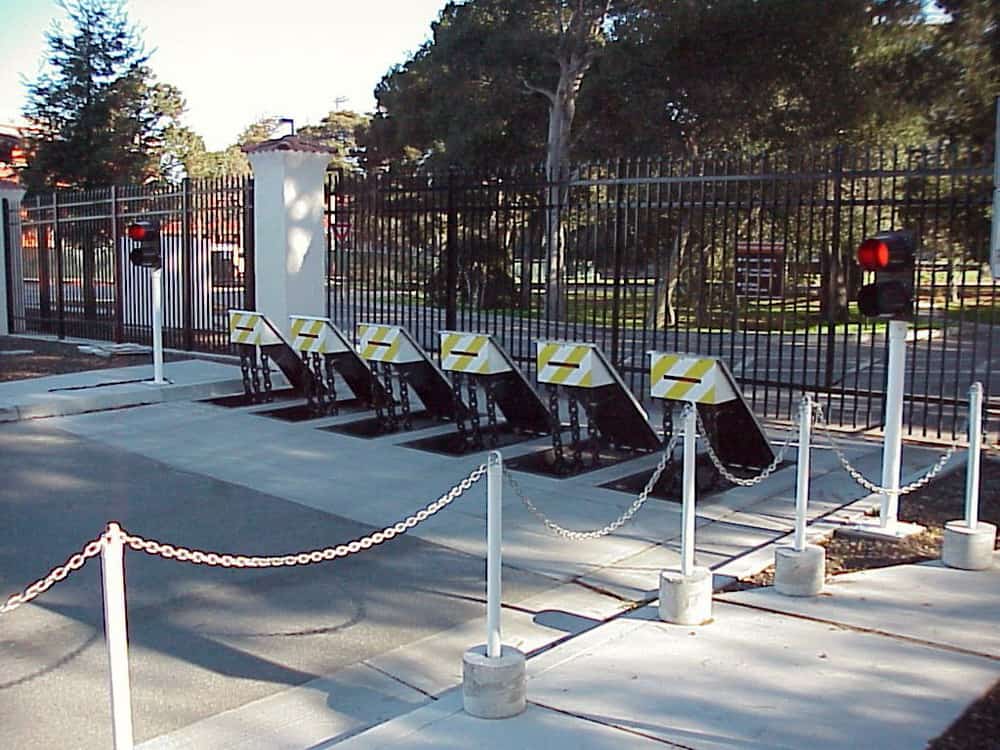
Article Summary
A deeper foundation does not automatically mean a stronger vehicle barrier. Delta Scientific’s DSC2000 uses an 11-inch shallow foundation, while the TT207S uses a 53-inch deep foundation, yet both carry the same K12/L3 crash rating. Foundation depth is primarily a site and installation consideration. Shallow foundations can help avoid underground infrastructure and minimize excavation depth. Deep foundations can reduce the lateral footprint while providing greater sump capacity. Start with the required crash performance. Then choose the foundation design that best fits the site.
If foundation depth determined barrier strength, these two products should perform very differently.
The Delta Scientific DSC2000 uses an 11-inch shallow foundation.
The TT207S uses a 53-inch deep foundation.
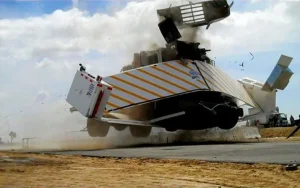
Yet both carry the same K12/L3 crash rating.
That is a 42-inch difference in foundation depth with no difference in crash rating.
So what does foundation depth actually tell us?
It tells us how the barrier is designed to work with the site.
That difference has real implications for how a barrier is selected and installed.
A shallow foundation may be the better fit when underground utilities, limited excavation depth, or other subsurface conditions make deep excavation difficult.
A deep foundation may be the better fit when lateral space is limited, greater sump capacity is beneficial, or the site can accommodate deeper excavation more easily than a wider foundation footprint.
The crash rating establishes the required stopping performance.
The foundation design helps us achieve that performance within the realities of the site.
That is the concept I want to walk through in this article.
Same Crash Rating. Very Different Foundations.
The DSC2000 and TT207S make a useful comparison because their crash performance is the same.
Their foundations are very different.
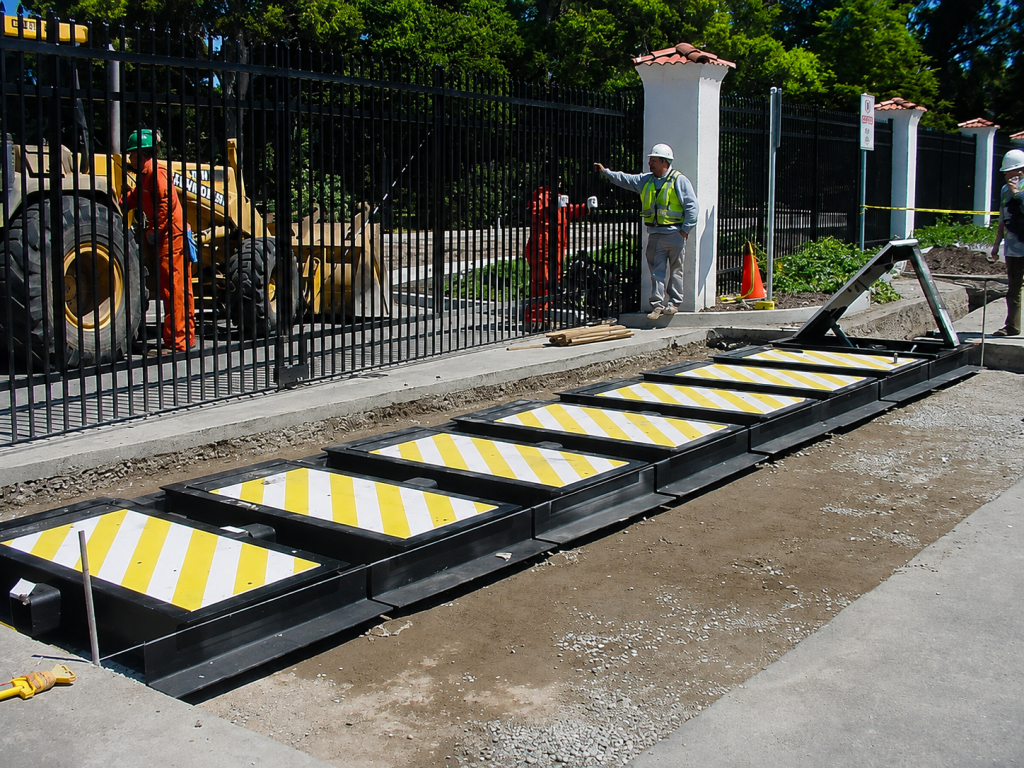
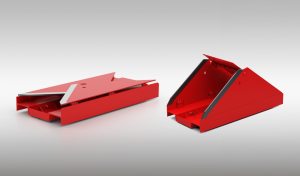
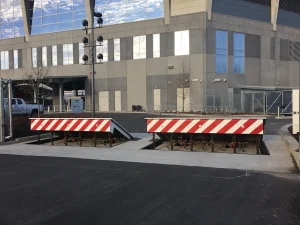
The DSC2000 shallow foundation wedge barricade spreads its foundation across a larger area while keeping excavation depth to approximately 11 inches.
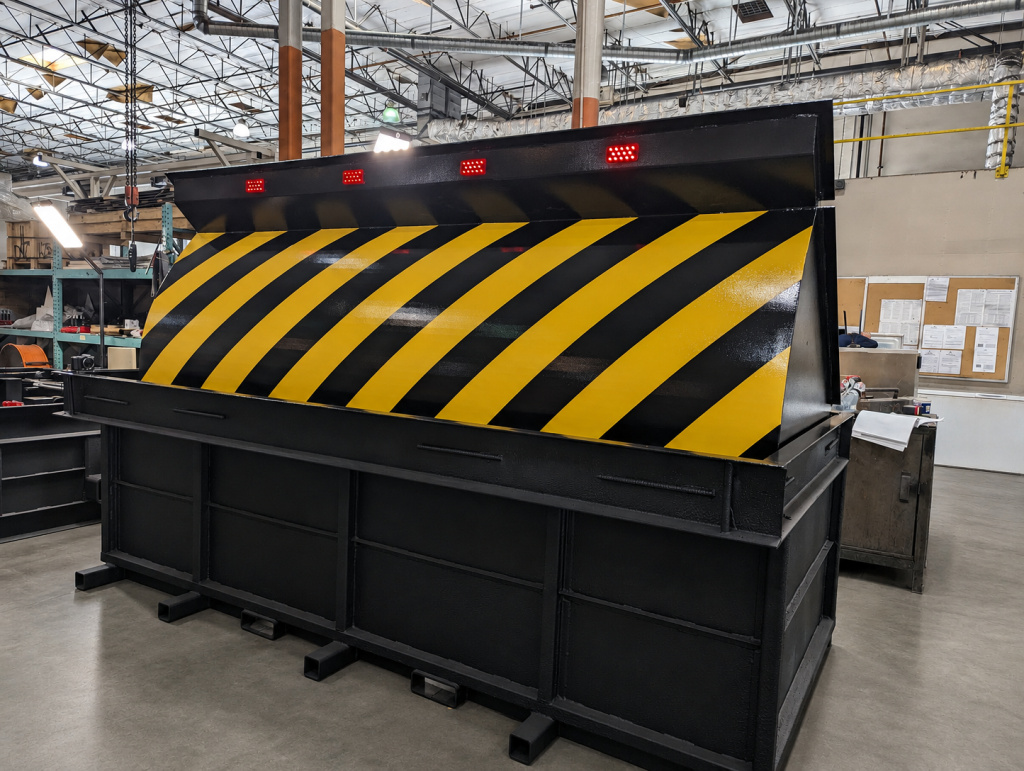
The TT207S deep foundation wedge barricade takes a different approach. Its foundation extends approximately 53 inches below the roadway.
Both designs achieve a K12/L3 crash rating.
This illustrates an important point for anyone specifying a crash-rated vehicle barrier.
Foundation depth should not be used as a shortcut for evaluating crash performance.
Start with the crash rating required for the application. Then look at the site and determine which foundation configuration makes sense.
Why Choose a Shallow Foundation Vehicle Barrier?
One of the first things we look at during pre-construction planning is what already exists below the roadway.
Many sites are crowded underground.
There may be electrical conduit, communications lines, drainage, utilities, existing concrete or other infrastructure running directly through the area where the barrier needs to be installed.
The deeper you excavate, the more likely you are to encounter those conditions.
Relocating existing infrastructure can add time, cost and complexity to a project. In some cases, relocation may not be practical at all.
This is where a shallow foundation vehicle barrier can provide a major advantage.
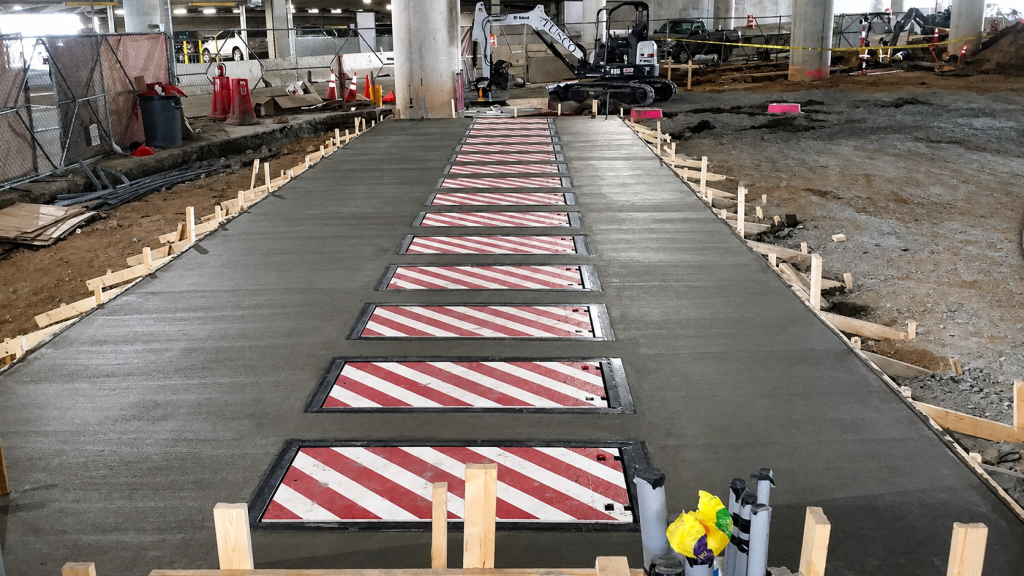
The DSC2000 requires only about 11 inches of foundation depth. Instead of going deeper, the foundation extends across a larger horizontal area.
If the site has enough lateral space, that shallow profile can help engineers work around underground obstacles while still meeting the required crash performance.
This can be especially valuable when installing a barrier at an existing facility.
You are rarely starting with a blank sheet of paper.
The infrastructure is already there. The barrier has to work around it.
When Does a Deep Foundation Barrier Make Sense?
There are also situations where a deep foundation vehicle barrier may be the better solution.
A site may have plenty of room to excavate vertically but very little room to expand the foundation horizontally.
Existing fence foundations are one example.
If a roadway is bordered by crash-rated fencing or other structures, the available space around the vehicle barrier may already be limited.
A deeper foundation can allow the barrier to fit within a more compact lateral footprint.
Construction phasing is another consideration.
At an active entrance, closing the entire roadway may not be an option.
If multiple barriers are being installed side by side, crews may need to keep one lane open while working on the adjacent lane. A foundation that extends too far laterally can interfere with that traffic.
A deeper, more compact foundation can help reduce that conflict.
The question becomes very practical.
Where does the site give you room to work?
Sometimes the answer is outward.
Sometimes it is downward.
Foundation Depth Can Also Affect Sump Capacity
There is another difference between shallow and deep foundation barriers that deserves attention.
The sump.
Vehicle barriers operate outdoors and collect debris over time.
Leaves, dirt, sand, trash and other material can enter the barrier area. That material needs somewhere to go.
A deeper foundation typically provides a larger sump beneath the barrier.
That additional sump capacity gives debris more room to collect before maintenance is required.
A shallow foundation has less vertical space available for that storage.
For facilities with heavy debris accumulation, drainage concerns or longer desired intervals between cleanouts, sump capacity may become an important part of the decision.
It is easy to focus entirely on installation when comparing foundation designs.
Long-term operation matters too.
A barrier may remain in service for decades. Maintenance access and cleaning requirements should be considered before the concrete is poured.
What Should You Consider When Selecting a Barrier Foundation?
When we help customers evaluate shallow foundation vs. deep foundation barriers, I recommend starting with the site rather than assuming one foundation style is universally better.
There are several questions worth asking early in the design process.
What crash rating does the site require?
This should come first. Determine the required level of vehicle impact protection before comparing foundation designs.
What is underground?
Identify utilities, conduit, drainage systems, existing foundations and other subsurface infrastructure.
How deep can you realistically excavate?
Site conditions may limit excavation depth or make deeper construction significantly more complicated.
How much lateral space is available?
A shallow foundation may require more horizontal area. Existing structures, fencing, roadways and adjacent lanes can limit that space.
Does traffic need to remain operational during construction?
Foundation footprint can affect lane closures and construction phasing.
How much sump capacity does the application need?
A larger sump can provide more room for water and debris and can influence maintenance requirements over the life of the barrier.
These questions help move the conversation beyond foundation depth alone.
Shallow vs. Deep Foundation Barriers: There Is a Tradeoff
The DSC2000 and TT207S demonstrate this clearly.
The DSC2000 provides K12/L3 crash performance with an approximately 11-inch shallow foundation. That shallow profile can be valuable when deeper excavation would conflict with underground infrastructure. The tradeoff is a larger horizontal foundation footprint and less sump capacity.
The TT207S provides the same K12/L3 crash performance with an approximately 53-inch deep foundation. The deeper design can provide a more compact lateral footprint and greater sump capacity. It requires considerably more vertical excavation.
Same crash rating.
Different approaches to solving the installation problem.
That is why I would never recommend selecting a vehicle barrier based on foundation depth alone.
Start With the Threat. Then Look Below the Surface.
Every perimeter security project starts with a performance requirement.
What type of vehicle threat are you designing for?
What crash rating does the application require?
Once that requirement is established, we can begin looking at the physical realities of the site.
The best barrier on paper can become the wrong barrier if installing it requires relocating major utilities, interfering with adjacent infrastructure or creating construction problems that another foundation design could have avoided.
Good pre-construction planning catches those issues early.
At Delta Scientific, we have spent decades designing and manufacturing crash-rated vehicle barriers for high-security facilities around the world. That experience has taught us to look at the entire installation.
The barrier above ground is only part of the system.
What happens below the surface can determine which solution makes the most sense.
The DSC2000 and TT207S prove the point.
11 inches. 53 inches. Same K12/L3 crash rating.
Foundation depth does not tell you how strong the barrier is.
It helps tell you how that barrier will fit your site.
Recent Posts


Frequently Asked Questions
Keith Bobrosky
Keith Bobrosky is President of Delta Scientific. A former applications engineer, he writes and speaks to the practical side of vehicle security, connecting crash ratings and standards to what works on real sites.