
What SAFETY Act Certification Means for Vehicle Barrier Projects

Article Summary
DHS SAFETY Act Certification is not a crash rating. It is a federal liability-protection framework for approved anti-terrorism technologies. For vehicle barrier projects, that matters because it affects how owners, integrators, architects, engineers, and installers think about legal exposure when they specify or deploy qualifying systems.
What the SAFETY Act means in plain English
The Support Anti-terrorism by Fostering Effective Technology Act, usually called the SAFETY Act, is a federal program administered by the U.S. Department of Homeland Security. The program gives liability protections to approved anti-terrorism technologies if claims arise from an act of terrorism. In practice, that means the law is about legal risk allocation, not just physical security performance.
For barrier projects, the most important point is simple: a SAFETY Act Certification can strengthen the legal position of the seller and can also extend meaningful protections through the broader project and delivery chain when the approved technology is deployed as part of a real site security program.
What Certification is, and what it is not
Certification should not be confused with a crash test standard. A crash rating, such as ASTM F2656, addresses whether a barrier stopped a defined vehicle at a defined speed and penetration level. SAFETY Act Certification addresses something different: whether DHS has approved the anti-terrorism technology for liability-protection purposes.
That distinction matters in specifications. A barrier can be crash tested without being SAFETY Act Certified, and a SAFETY Act Certified product still needs to match the project’s threat model, approach speed, site geometry, foundation limits, lane width, operations plan, and access-control requirements. The right way to think about it is this: crash performance answers “will it stop the vehicle,” while SAFETY Act status helps answer “how is liability handled if a terrorist incident leads to claims.”
Certification vs. Designation
DHS offers Designation and Certification under the SAFETY Act. According to DHS, Designation provides a liability cap tied to the insurance amount required by DHS, along with other litigation protections such as exclusive action in federal court and limits on certain damages. Certification adds to those protections by allowing the seller to assert the Government Contractor Defense for claims arising from acts of terrorism.
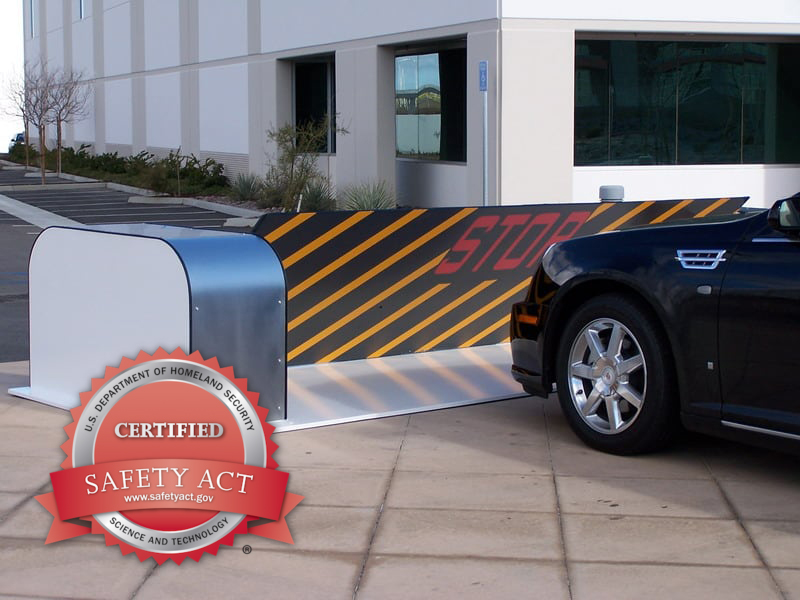
In plain English, Certification is the stronger approval level. It signals a higher level of DHS confidence that the technology performs as intended and is safe for its intended use. That is why Delta’s catalogue and SAFETY Act page emphasize the Red Seal Certification level, rather than only a lower-tier designation.
Why this matters to owners, integrators, and A/Es
This is where the SAFETY Act becomes a procurement and risk-management issue, not just a product-detail issue. Delta’s current SAFETY Act Certified Barriers page states that the protections extend beyond the manufacturer to contractors and integrators installing the products, architects and engineers specifying them, and end users operating them on site.
That does not mean every project automatically becomes litigation-proof. Site-specific facts, deployment scope, operational use, contract language, and the nature of the incident still matter. But it does mean a SAFETY Act Certified barrier can be relevant when an owner is comparing risk posture across product families, especially on high-consequence sites such as federal facilities, data centers, stadiums, transit sites, and other dense public or critical locations.
For architects and engineers, the practical takeaway is that SAFETY Act status can support a more defensible specification on projects where anti-terrorism planning is part of the brief. For integrators and installers, it can matter when aligning scope, insurance, and project documentation. For owners, it can become one more reason to evaluate more than crash rating alone.
Which Delta products are covered
Delta’s current SAFETY Act page lists active and passive barriers across wedge barriers, bollards, beam barriers, crash gates, and portable systems. The published list includes the following model families and products:
- MP5000
- MP5000-M50
- HD300
- DSC550
- HD200
- DSC1200
- DSC2000
- DSC501
- DSC600
- DSC633
- DSC635
- DSC650
- DSC720-1M
- DSC800
- DSC288
- DSC7000
- DSC1500
- DSC7090
- TB100
- TB150
Because published product lists can be updated, it is smart to verify the current covered models and terms of coverage with Delta during procurement, especially if your project is using an older basis-of-design sheet or a legacy specification.
How to use SAFETY Act status in a real barrier project

1. Start with the threat and the site
Do not lead with the legal label alone. Start with approach speed, vehicle path, lane width, pedestrian density, asset value, utility conflicts, and operational needs. Then narrow the barrier type and crash rating.
2. Treat SAFETY Act status as a layer of project value
Once the physical solution is right, SAFETY Act Certification can strengthen the conversation around liability, insurance, procurement defensibility, and owner comfort. It is an added project attribute, not a substitute for engineering.
3. Document the basis of design clearly
If a project team is relying on crash rating, certification status, or both, the specification should say so plainly. Owners and consultants should also keep product documentation aligned with approved model numbers, control options, and installation intent.
Choose the right barrier, then confirm the right approvals
For many high-security projects, the best answer is not simply “use a SAFETY Act Certified barrier.” The better answer is to match the site to the right barrier family first, then confirm the right crash rating, installation conditions, controls, and approval path. That is especially true when the project involves federal stakeholders, dense public exposure, or high-value assets.
If you are evaluating active or passive anti-ram systems and want to confirm which Delta products are covered, talk with Delta Scientific or request a quote for the current SAFETY Act status, product documentation, and fit for your entry points or perimeter plan.
Recent Posts




Frequently Asked Questions
Delta Scientific
Delta Scientific Corporation is the world’s leading manufacturer of vehicle access control equipment. Delta Scientific has been engineering and manufacturing vehicle access control equipment and selling its products worldwide since 1974.