
Portable Vehicle Barriers for Events: Protecting Streets Without Permanent Construction
Article Summary
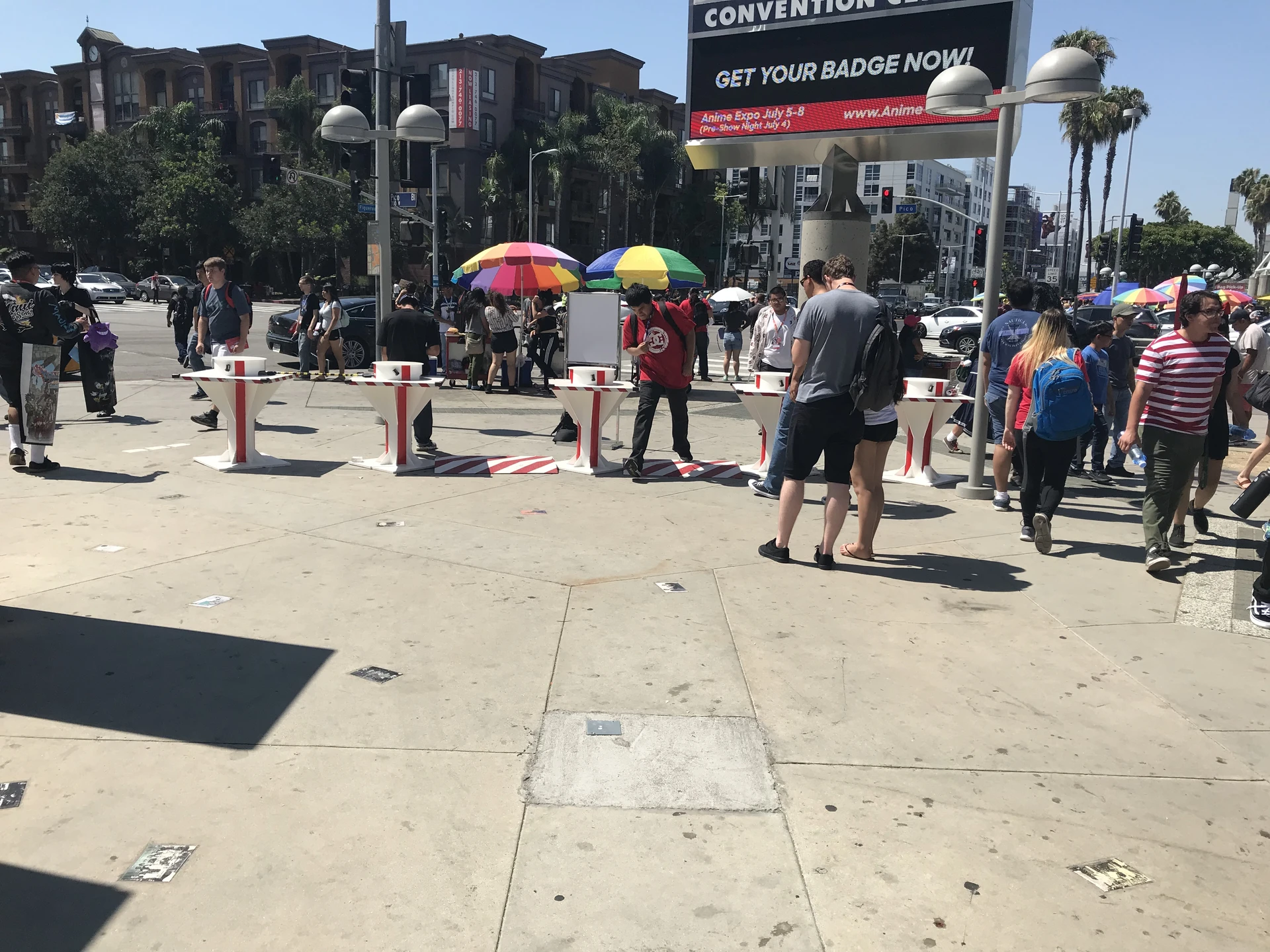
Crash-tested portable barriers let you secure festivals and parades without permanent foundations, as long as you pick the right rating and place units where vehicles can actually approach.
Most event security plans have the same constraint: you need protection for a weekend, not a capital project. Portable vehicle barriers for events solve that by deploying on existing surfaces, then leaving with the event.
The difference between a “street closure” and a “vehicle-stopping layer” is documentation. Traffic-control tools manage movement. Crash-tested systems document how they perform when a vehicle hits them.
Why Temporary Traffic Control Is Not A Vehicle Barrier
Cones, signs, fencing, and light barricades are still required. They create order and reduce confusion. They are not designed or tested to arrest a moving vehicle.
If your risk assessment calls for hostile vehicle mitigation (HVM), plan for two layers: (1) traffic control and staffing to keep vehicles away and slow approach speeds, and (2) crash-tested barriers at specific access points. CISA maintains vehicle-ramming mitigation resources that many teams use as a starting point for planning and self-assessment.
Crash Ratings In Two Minutes
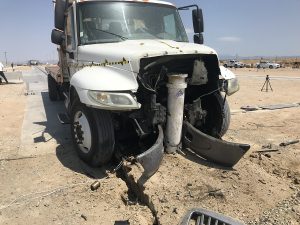
ASTM F2656/F2656M is a standard test method used to establish a penetration rating for vehicle security barriers in a controlled impact test. ASTM also cautions that a penetration rating does not imply identical performance in every site condition, approach route, or topography.
For the medium-duty truck test vehicle, M-ratings reflect impact speed (M30, M40, M50). P-ratings reflect penetration distance after impact. Lower P numbers mean less penetration and usually allow tighter setbacks behind the barrier line.
Some rapid-deployment products are tested to different vehicle classes, such as SC (small car). That can be useful at pedestrian edges, but it is not an M-rating and should not be treated as equivalent at primary vehicle approaches.
Rapid-Deployment Options For Events
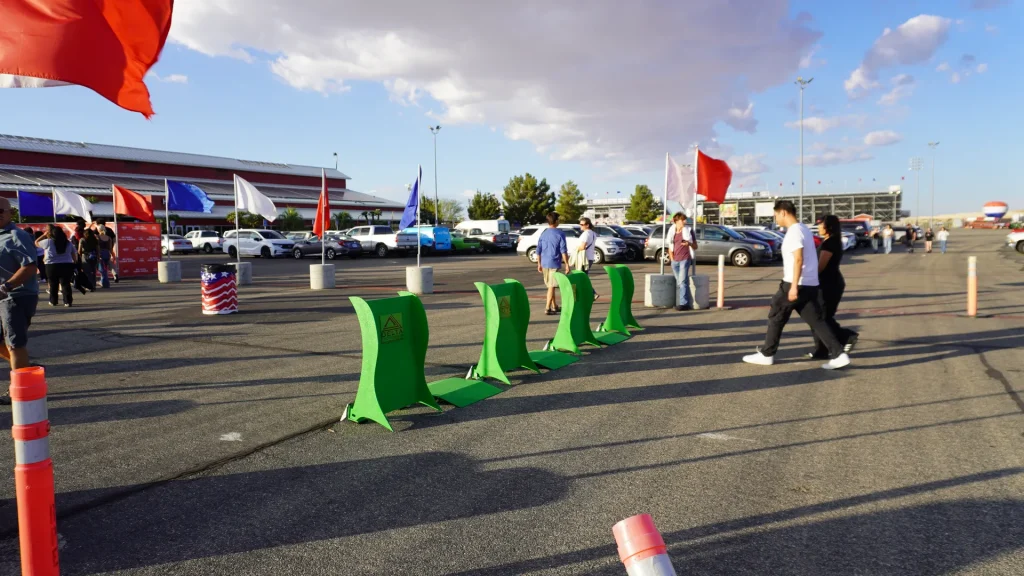
Delta’s portable lineup covers four common event needs: road closures, modular barrier lines, walkable pedestrian entries, and fast-deploy crowd-edge protection.
MP5000 Tow-In Wedge Barrier (M40 Or M50 Variant)
Use a tow-in wedge barrier when you need a hard road closure or a managed vehicle entry point. Delta’s catalog lists MP5000 as M40 and MP5000-M50 as M50, and the MP5000 product page shows event and venue use cases.
MP100 Modular Barrier (M30/P3 In Arrays Of Five)
Use MP100 when you need a portable barrier line that can be staged quickly and stored compactly. Delta states MP100 was crash tested to ASTM F2656-23 M30/P3 when used in an array of five, and the units are designed to stack and move with a transporter.
TB100 And TB150 Portable Bollard Arrays (Walkable Openings)
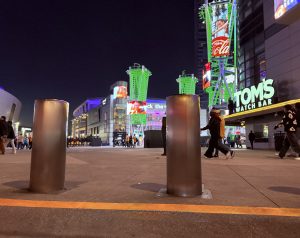
Use portable bollard arrays at pedestrian entries or narrow corridors. Delta states TB100 is ASTM M30/P3 in arrays of five, and TB150 is ASTM M50/P3 in arrays of ten, keep openings walkable while denying vehicle access.
DSC50 “S” Barrier (Portable Crowd Protection Barricade, ASTM SC30)
Use the DSC50 “S” Barrier for fast deployment along pedestrian edges. Delta lists the DSC50 as ASTM SC30. Treat it as a crowd-edge layer, not a replacement for an M-rated barrier at a primary vehicle approach.
Three Layout Patterns That Work
Parade Route Cross Streets
Cross streets are where vehicles can enter the route. Close major approaches with the rated barrier line, then use cones and fencing to channel pedestrians away from the setback area behind the barriers.
Street Festival With Vendor Loading
Festivals fail when every opening becomes a vehicle opening. Concentrate vehicle access to one managed point, and protect pedestrian entries with walkable arrays.
Open Streets With Transit Or Emergency Needs
When streets must still function, the barrier plan is mostly operations. Define which points are hard closures and which are managed entries, then staff them accordingly.
Submittal Checklist For Event Deployment
Conclusion
You do not need to pour concrete to add real protection to a street event. You do need documented performance, smart placement, and a clear operating plan for access points.
If you want help selecting portable vehicle barriers for events and laying them out on your footprint, review Delta’s portable vehicle barriers and request the cut sheets for MP100, MP5000, TB100/TB150, and the DSC50 “S” Barrier. Then contact Delta Scientific to review your plan.
Recent Posts



Frequently Asked Questions
Keith Bobrosky
Keith Bobrosky is President of Delta Scientific. A former applications engineer, he writes and speaks to the practical side of vehicle security, connecting crash ratings and standards to what works on real sites.