
Shallow-Foundation Wedge Barriers for Sites With Utilities and High Water Tables

Article Summary
Deep barrier pits and thick foundations are often impossible on retrofit sites because of buried utilities, high groundwater, or weak soils. Shallow-foundation wedge barriers reduce excavation depth (often around 24 inches on certain models) while still delivering certified crash performance, including M50 and M30 ratings, when specified and installed correctly.
The problem: you need vehicle stopping power, but you can’t dig.
Many barrier projects start with a simple requirement: stop a vehicle from entering a protected area. Then the first test pit gets excavated and reality shows up: duct banks, fiber, storm drains, unknown utilities, or a water table that turns the hole into a sump.
On retrofit sites, deep foundations can trigger major scope creep: utility relocation, dewatering plans, shoring, and unexpected permitting. That can push owners toward “temporary” traffic devices, even when the risk requires a crash-rated security barrier.
Shallow-foundation wedge barriers exist for this exact constraint. They are designed to deliver certified crash performance with reduced excavation depth, so you can solve the security problem without rebuilding the underground site.
What is a shallow-foundation wedge barrier?
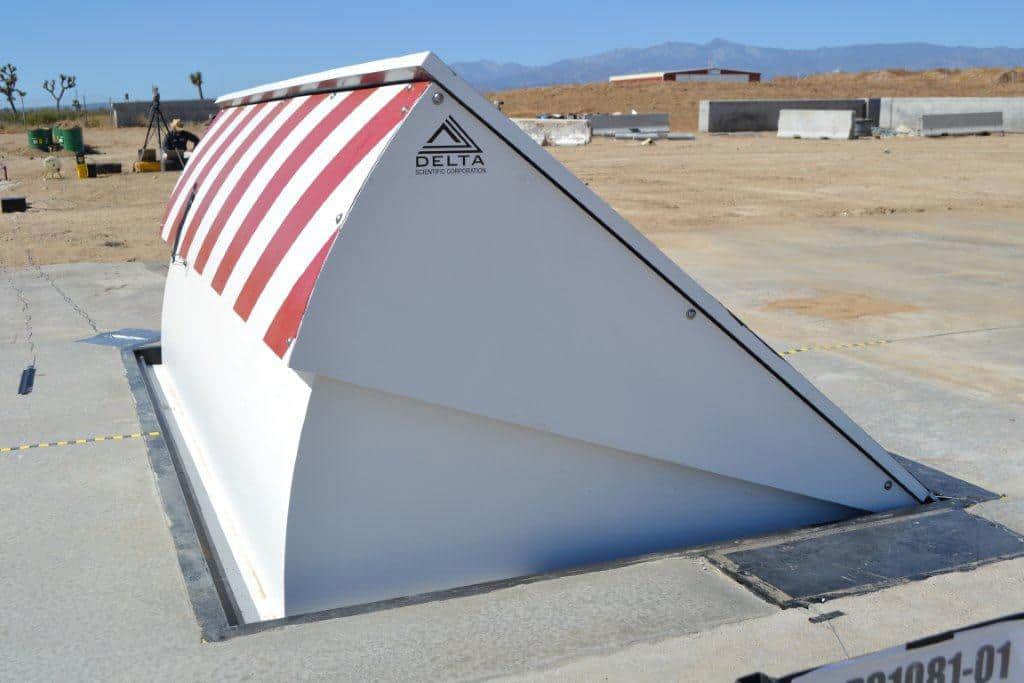
A wedge barrier (also called a wedge barricade) is an in-ground active barrier that raises a steel wedge to block a vehicle lane. In the retracted position, it is flush or near-flush to grade for normal vehicle flow. In the deployed position, it creates a physical stop line.
“Shallow foundation” means the barrier is engineered to install with reduced excavation depth compared to deep-pit designs. On many projects, that can be the difference between a straightforward installation and a full utility relocation project.
Delta wedge barrier category overview: High Security Wedge Barricades.
Why deep pits are not viable on many sites
Buried utilities and duct banks
Urban curb lines, campus entries, and facility driveways often carry power, communications, fiber, and drainage in crowded corridors. Deep pits increase the chance of conflicts and increase the cost of reroutes and shutdowns.
High water table and poor drainage
A high water table turns excavation into ongoing dewatering. Even if you can install the barrier, reliability suffers if the pit becomes a water management problem. Shallow designs reduce excavation exposure and can simplify drainage planning, but they still require a defined water management approach.
Weak soils, corrosive soils, and constructability limits
Not every site can support heavy civil work or extended closures. Some projects must keep lanes open, avoid deep shoring, and limit excavation time. Shallow foundations can reduce schedule risk and installation complexity when soils or access make deep construction impractical.
Crash rating still comes first: shallow does not mean “light duty”

If the risk requires stopping a vehicle, write the requirement around a recognized crash test standard and a required rating. In the U.S., many security barriers are rated to ASTM F2656, which includes an impact speed class (M-rating) and a penetration category (P-rating).
Key point: on tight sites, penetration matters as much as speed. A barrier can be “M50” and still be wrong for your layout if the allowed penetration exceeds available standoff.
How shallow foundations solve the constraint (and where they don’t)
Shallow-foundation wedge barriers are designed to reduce excavation depth, often to around 24 inches on certain shallow systems, which helps avoid utilities and reduces dewatering exposure. That can open up projects that would otherwise be infeasible.
What shallow foundations do not eliminate: you still need civil coordination for drainage, conduits, and pavement restoration. You also need to confirm the barrier footprint and foundation requirements against your geotechnical and utility data.
Shallow-foundation wedge barrier examples (Delta models)
HD300: shallow foundation, M50/P1 crash-rated wedge barrier
Delta’s HD300 wedge barrier is listed as an ASTM M50/P1 crash-rated barrier and a shallow foundation design. See HD300 wedge barrier details.
Where it fits: high-security lanes where M50 performance is required, but deep excavation is constrained by utilities or constructability limits.
Foundation depth note: Delta references shallow installation for HD300. One Delta demonstration notes a 24-inch shallow foundation for HD300. Verify exact foundation depth and civil requirements on the project drawings and manufacturer submittals.
DSC550: open-frame shallow foundation barrier with a 24-inch foundation
Delta’s DSC550 shallow foundation barricade is described as having a shallow 24-inch foundation and is certified to ASTM M50/P1. See DSC550 product details.
Where it fits: sites where underground utilities are dense and owners want to reduce installation complexity, time, and materials while still meeting a high crash rating.
Brochure reference (PDF): DSC550 brochure.
HD200: shallow foundation wedge barricade, M30/P1
Delta’s HD200 wedge barricade is listed as an ASTM M30/P1 crash-rated shallow foundation barrier. See HD200 product details.
Where it fits: lanes that need a robust active barrier but where the design basis supports M30 performance, often in high-traffic control points. Delta also publishes procurement documentation indicating the HD200 system can be installed with a 24-inch foundation depth. Confirm with current submittals.
Procurement specification (PDF): HD200 procurement specification.
Layout patterns that work on constrained sites
Pattern 1: retrofit driveway with unknown utilities
Goal: add a crash-rated stop line without relocating the entire utility corridor. Approach: use a shallow-foundation wedge barrier at the primary lane, then use fixed bollards or barriers to close bypass routes around the lane. Key details: confirm clear opening and turning paths, protect bypass paths, and define a protected line and standoff distance in the drawings.
Pattern 2: high water table site with limited drainage options
Goal: maintain barrier reliability without turning the pit into a constant pump-and-clean problem. Approach: select a shallow foundation system, then engineer drainage, access for cleaning, and winterization (where applicable). Key details: define responsibility for trench drains/sumps, ensure maintenance access, and document inspection cadence.
Pattern 3: lane control during phased construction
Goal: keep lanes open while upgrading security in stages. Approach: plan barrier installation windows, temporary lane shifts, and bypass protection. Key details: include detection loops/traffic signals early, and coordinate with access control and guard operations if present.
Spec checklist for shallow-foundation wedge barriers
Use performance language. Avoid “shallow” as the only requirement. Specify what the system must do and what constraints it must fit.
Next step: If you are dealing with utility conflicts or a high water table and need a crash-rated lane solution, send your plan set and constraints to Delta for a layout-based recommendation. Contact Delta Scientific to request a quote or technical review.
What to watch for during installation and commissioning
Conclusion
If your site has buried utilities, high groundwater, or soils that make deep pits impractical, shallow-foundation wedge barriers can keep the project feasible without downgrading security performance. The key is matching rating and penetration to available standoff, then designing the civil and drainage interfaces so the barrier stays reliable
Recent Posts




Frequently Asked Questions
Delta Scientific
Delta Scientific Corporation is the world’s leading manufacturer of vehicle access control equipment. Delta Scientific has been engineering and manufacturing vehicle access control equipment and selling its products worldwide since 1974.