
Bollards and Barriers for Parking Garages and Ramps: Practical Protection at Exits, Pay Areas, and Retail

Article Summary
Parking garages concentrate vehicles, pedestrians, and hard surfaces in tight geometry. Good protection focuses on the predictable conflict points: ramp ends, pedestrian exits, pay areas, and ground-floor retail edges. Select bollards and barriers based on the likely impact scenario (low-speed bump vs higher-speed approach) and the structure’s constraints (headroom, slab thickness, and utilities).
Why parking garages need a different approach
In most facilities, vehicles and pedestrians can be separated with distance. Garages compress everything: turning movements, ramps, columns, doors, and queue lines. That means the same site can have two different impact problems. One is common and low-speed, like a driver misjudging a turn at a ramp end. The other is less common but higher consequence, such as a vehicle reaching a pedestrian exit or ground-floor retail frontage at a higher speed than the designer assumed.
Start with scenarios: low-speed contact vs higher-speed approach
Garages typically face a mix of hazards. Most are low-speed impacts caused by tight turning radii and poor sight lines. But some garage layouts create longer approach paths, especially at entries, exits, and ground-level drive lanes, where speeds can increase.
A practical way to plan is to label each location as one of two categories:
If you need stopping performance, use systems with published crash-test results tied to a recognized standard, such as ASTM F2656 (M rating plus penetration rating).
Garage locations that deserve attention
Ramp ends and tight corners
Ramp ends are a repeat collision point. Drivers accelerate uphill or brake downhill, then turn into a landing with columns and walls close to the travel path. Use robust low-speed protection to keep a minor driving error from becoming a pedestrian incident at the landing.
Typical measures include fixed bollards at the inside corner, wheel stops positioned to keep vehicles off pedestrian edges, and clear striping that reduces late turns.
Pedestrian exits, stairs, and elevator lobbies
Pedestrian exits in garages often open directly into vehicle circulation. Protect the door area and the first few feet of pedestrian path. If the exit is adjacent to an approach lane with meaningful speed or a direct line-of-travel, evaluate whether a crash-rated bollard line is warranted.
Payment areas and queuing lanes
Pay-on-foot stations, pay-in-lane equipment, and gated queue lanes create a high exposure point because vehicles stop, start, and crowd close to equipment and pedestrians. Low-speed protection is often appropriate here, but do not ignore the straight-line approach risk if the lane is long and drivers can gain speed.
Ground-floor retail at the base of the garage
Retail edges are where garage traffic meets public-facing pedestrian activity. The hazard is not only parking bumps. It is also approach geometry. If a vehicle can drive directly toward storefront glazing or outdoor seating, that is where crash-rated bollards may be appropriate.
Headroom and structural constraints: what changes in garages
Garages are structural systems. Your barrier choice has to respect the slab, post-tensioning, embed depth limits, and overhead clearance.
Headroom limits
Low headroom affects any solution that rises, swings, or requires overhead hardware. In many garages, overhead clearances are tight due to beams, signage, sprinklers, and lighting. That can push designs toward low-profile fixed solutions at pedestrian edges and careful placement of any active system at entry lanes.
Slab thickness, utilities, and post-tension conflicts
Foundations in garages are not like foundations in open ground. Slabs may be thin, post-tensioned, or full of embedded conduit. That is why shallow foundation bollard modules can be valuable on retrofit projects where deep excavation is not viable.
Example of a shallow foundation module approach: DSC600 fixed bollard modules. Use manufacturer details and your structural engineer to confirm compatibility with the slab and reinforcement.
Bollards vs other barrier types in garages
Bollards are often the default because they fit tight geometry and protect pedestrians along edges. But garages also use beams and gates at entries, and in some cases active barriers when the access point must be controlled and the threat requires it.
Fixed bollards
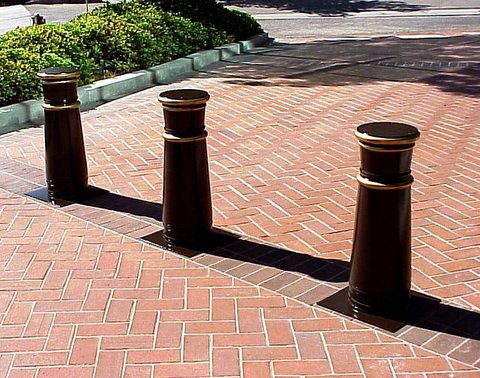
Fixed bollards are common at pedestrian exits, retail edges, and ramp landings. They can be decorative or security-focused. If the goal is vehicle stopping performance, confirm that the bollard system has published test evidence and that spacing and foundations match the intended hazard.
Retractable bollards at controlled entries
Retractable (rising) bollards, such as the DSC305 Automatic Retractable Bollard System, can be used where the garage entry is a control point and the site needs on-demand opening and closing. In garages, the key constraints are pit depth, drainage, and maintenance access. If those cannot be solved cleanly, fixed solutions may be a better fit.
Beam and gate systems for lane control
Many garages already use gate arms for revenue control. Those are traffic devices, not security barriers. If you need a more robust lane barrier, barrier beams and sliding gate systems can provide clearer lane control, but you still need to align the system with headroom and the civil/structural interfaces.
A practical layout checklist
Use this to brief design and operations. It keeps the focus on where protection matters and what the garage can physically support.
Conclusion
Garages are predictable. The same points cause problems again and again: ramp ends, pedestrian exits, pay areas, and retail edges. Start by separating low-speed contact protection from true vehicle stopping requirements. Then choose bollards and barriers that fit the structure’s headroom and slab constraints, and validate any crash-rated performance with published documentation and correct installation details.
Next step: If you are upgrading a garage entrance, adding protection at pedestrian exits, or hardening ground-floor retail edges, Delta can review your layout and constraints. Contact Delta Scientific to request a quote or technical review.
Recent Posts





Frequently Asked Questions
Delta Scientific
Delta Scientific Corporation is the world’s leading manufacturer of vehicle access control equipment. Delta Scientific has been engineering and manufacturing vehicle access control equipment and selling its products worldwide since 1974.