
ADA Requirements for Bollards: Clear Widths, Detectability, and Safe Layouts

Article Summary
There is no single ADA section labeled for bollards. In practice, bollard layouts have to satisfy the ADA rules that govern accessible routes, clear width, and protruding objects while still doing the job of stopping vehicles.
For most projects, that means keeping the required pedestrian route open, making sure the bollards do not create detection hazards, and coordinating spacing and placement with the actual path people will use.
What the ADA Actually Regulates Around Bollards
Bollards matter under the ADA because they sit in places people use to move through a site: sidewalks, entries, passenger drop-offs, storefront approaches, plazas, and campus walkways. The 2010 ADA Standards for Accessible Design set the enforceable minimum requirements for newly constructed and altered facilities covered by Titles II and III. For bollards, the key issue is usually not the post itself. It is whether the post changes the accessible route or creates a hazard along the circulation path.
That is why teams should avoid looking for a single universal “ADA bollard rule.” A better approach is to check three questions early in layout: where the accessible route runs, how much clear width the route needs to keep, and whether the bollard or any attached element creates a protruding object problem. Delta’s bollard code requirements guide is a good starting point for the broader code side, but accessibility still needs its own review.
Keep the Accessible Route Open
The U.S. Access Board’s accessible route guidance explains the core rule clearly: accessible routes need a continuous clear width of at least 36 inches, with a limited reduction to 32 inches at certain short points such as doorways. That should shape bollard placement from the start. If the posts pinch the path below the required clear width, the layout fails even if the barrier line looks reasonable on paper.
In real projects, this often means measuring the true pedestrian path, not just the distance between two posts. Curbs, planters, door swings, wall offsets, and site furniture can all narrow the usable route. At turns, the route may need more space than the straight-line minimum. The Access Board also notes that tighter 180-degree turns around narrow obstructions require added width, so a bollard line near a bend deserves extra attention.
A practical rule is simple: do not let bollards become the narrowest point on a path people rely on for accessible travel. When you need vehicle control at a storefront, quad, or plaza edge, place the barrier line so the accessible route remains obvious and continuous, not squeezed into leftover space.
Make Bollards Cane Detectable and Avoid Protruding Hazards
The next issue is detectability. The Access Board’s protruding object guide explains that objects with leading edges within cane sweep, 27 inches high maximum, do not pose the same hazard as objects whose leading edges sit above that zone and below the 80-inch headroom threshold. In plain English, a low object that a cane can find is treated differently from an element that hangs or projects into the path where a person may not detect it soon enough.
For bollards, that usually means the post itself is not the problem because it extends from the ground up and is physically detectable. Problems tend to appear when teams add chains, sign panels, hardware, decorative caps, or mounted accessories that project into the route at the wrong height. The ADA protruding object rules also apply to circulation paths generally, not only to formal accessible routes, so plazas and exterior walks deserve the same discipline.
This is also why layout details matter more than product labels. A post can be ADA-compatible in one condition and create a hazard in another. The safest approach is to keep any added elements out of the pedestrian envelope or within the cane-detectable zone, then verify the route width again after all accessories are accounted for.
Lay Out Bollards for Real Pedestrian Movement
Good bollard design balances two jobs at once: block the vehicle path and preserve a usable pedestrian path. That usually points to simple, deliberate layouts. Keep the accessible opening where people naturally approach. Avoid forcing wheelchair users to make awkward turns around the ends of an array. Do not set one stray post inside the route where it becomes an isolated pinch point.
When shallow excavation or retrofit constraints drive the design, foundation choices should not come at the expense of accessible circulation. Delta offers shallow foundation bollards for sites where utilities or slab conditions limit depth, and it also offers broader high-security bollard systems for projects that need tested vehicle resistance. The accessibility review still happens at the plan level: route width, turning conditions, edge conditions, and visibility for pedestrians and drivers.
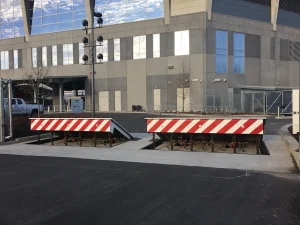
Where a site needs both daily pedestrian access and occasional vehicle entry, retractable bollard systems can help keep the normal route open while preserving controlled access for service, emergency, or authorized vehicles. The key is to plan the opening as part of the accessible circulation network, not as an afterthought.
Apply the Rule in Common Site Conditions
At storefronts, the usual question is whether the bollards protect the façade without blocking the front door approach. In that condition, teams often need to think about low-speed vehicle threats, utility conflicts, and decorative sleeves, but the ADA review still starts with the route to the entrance and the clear maneuvering space around it.
On campuses and civic sites, the issue is often wider: keeping service vehicles out of pedestrian zones without making the walk feel cluttered or confusing. Here, an orderly bollard line with one clear accessible opening generally works better than scattered posts that create multiple partial gaps.
At retrofit sites, do not assume an existing walkway can absorb a new bollard line. Re-check the path from parking, passenger loading, and public sidewalks into the entrance sequence. The ADA minimums are not decorative guidelines. They are enforceable access requirements, and they should be resolved before a security detail becomes a construction problem.
If you are trying to balance vehicle protection with ADA access, Delta can help you review bollard layouts, foundation constraints, and product options before the design gets locked in. Visit Request a Quote or Contact Us to discuss your site conditions and project goals.
Recent Posts




Frequently Asked Questions
Delta Scientific
Delta Scientific Corporation is the world’s leading manufacturer of vehicle access control equipment. Delta Scientific has been engineering and manufacturing vehicle access control equipment and selling its products worldwide since 1974.