
Multiple Hit Capability: Is Your Barrier Ready For A Second Attack?

When people evaluate a crash-rated vehicle barrier, they usually focus on one number.
M30. M50. K12. K54.
Those ratings matter. They prove a barrier can stop a vehicle under controlled test conditions.
But I always ask one more question:
What happens after the impact?
Because real attacks do not always end with a single vehicle.
A determined attacker may use multiple vehicles. They may exploit damage from the first impact. Security personnel may also need to reopen an entrance quickly after an accidental collision or attempted breach.
A barrier that stops one truck but cannot function afterward leaves a facility vulnerable.
That is why I believe multiple hit capability deserves far more attention than it receives.
Looking Beyond the Crash Rating
Crash testing measures whether a barrier successfully stops a specified vehicle at a specified speed.
It does not necessarily tell you how well that barrier survives the impact.
Some barriers require extensive reconstruction before they can protect a site again. Others can return to service quickly with minimal repairs.
That difference becomes critical when protecting military installations, government facilities, utilities, embassies, airports, and other critical infrastructure.
Your security system should be ready for what comes next.
The TT280 High Security Sliding Gate
One of my favorite examples is our TT280 High Security Gate.
During its official crash testing, the gate endured three separate crash attempts.
Three impacts. The gate was still standing.
That performance demonstrates the strength of the overall structure, not simply its ability to pass a single certification test. It reflects the engineering philosophy behind the product. Build it to protect today. Build it to protect tomorrow.
The DSC501 Wedge Barrier
The DSC501 remains one of the best demonstrations of multiple hit capability I have ever seen.
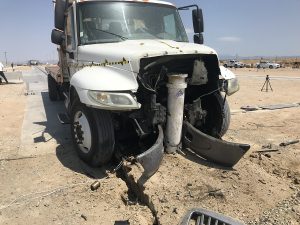
During its K54 crash test, the barrier stopped a 65,120 pound dual axle truck traveling 50 mph.
The truck was destroyed.
The barrier remained in the raised position, preventing any follow-on vehicle from passing after the initial attack.
Sandia National Laboratories documented the post-test condition in detail. After debris was removed, Delta technicians replaced damaged hydraulic fittings, isolated one damaged cylinder, and returned the barrier to operation using the remaining cylinder. The barrier was functioning again in approximately two hours. Sandia concluded that all structural components remained intact and that the barrier would “undoubtedly perform well against a second attack vehicle.” The repair hardware cost was reported to be under $25.
Those are remarkable results.
The crash test proved the barrier could stop one of the largest certification vehicles in the industry, achieving what no other barrier has.
The post-test inspection proved it was ready to keep protecting the site.
The DSC50 Crowd Protection Barrier
Multiple hit capability also matters for portable crowd protection.
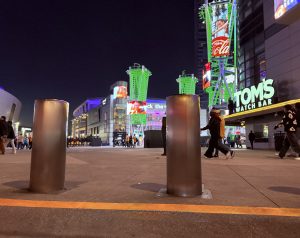
Our DSC50 “S” barrier was designed to protect pedestrians in busy public spaces while remaining practical for repeated deployment.
After its SC30 crash test, the barriers remained fully intact.
The only visible damage was minor paint scuffing.
No structural failure. No major repairs.
The barriers were ready for deployment again.
For municipalities, stadiums, event venues, and temporary security operations, that durability translates directly into lower lifecycle costs and greater operational readiness.
Engineering for the Real World
Crash testing is essential.
It provides an objective benchmark that every reputable manufacturer should meet.
But certification is only the beginning.
The questions I encourage buyers to ask are simple.
- How much damage did the barrier sustain?
- Can it remain upright after impact?
- How quickly can it return to service?
- Can it stop another vehicle?
Those answers reveal far more about long-term performance than a crash rating alone.
Protection Doesn’t End With the First Impact
At Delta Scientific, we have always believed that a vehicle barrier should do more than pass a test. It should continue protecting the people behind it.
That philosophy has guided our engineering for decades, and it continues to shape every new product we build.
Recent Posts



Keith Bobrosky
Keith Bobrosky is President of Delta Scientific. A former applications engineer, he writes and speaks to the practical side of vehicle security, connecting crash ratings and standards to what works on real sites.