
Crash-Rated Beam Barricades for High-Volume Vehicle Lanes
Article Summary
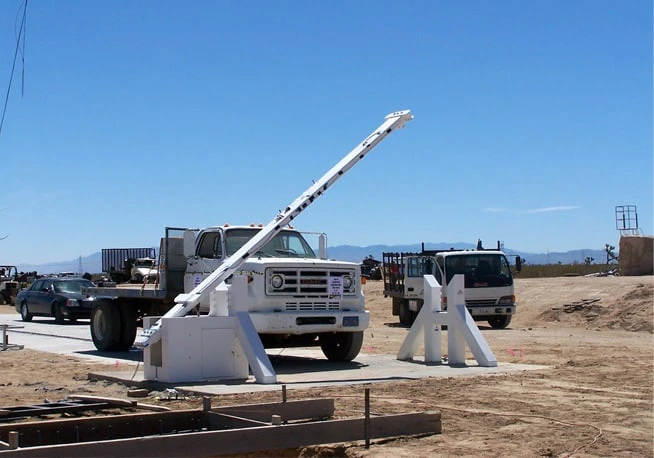
Crash-rated beam barricades control wide vehicle lanes without requiring a deep roadway cut. They are often a good fit when you need high throughput, clear lane signaling, and a barrier that integrates with access control, especially where in-ground foundations are constrained.
What is a crash-rated beam barricade?
A beam barricade is a lane barrier that blocks vehicles with a rigid horizontal beam. In a security application, “crash-rated” means the system is tested to a recognized vehicle impact standard and can stop a defined test vehicle at a defined speed with measured penetration. This is not the same as a parking gate arm, which is designed for traffic control, not vehicle stopping.
In the U.S., crash ratings are commonly expressed using ASTM F2656 (M rating plus penetration category).
Why beam barricades are used on high-volume lanes
When lanes are busy, the barrier needs to do two things well: manage throughput and enforce control. Beam systems are often used because they provide a clear, visible stop line across a lane and can be operated quickly and repeatedly when paired with proper controls and safety devices.
Beam barricades are commonly considered when:
- You have wide lanes or multiple lane widths that are hard to protect with a single in-ground barrier.
- You need frequent authorized access (delivery traffic, staff and visitors, shift changes).
- Roadway cutting or deep excavation is not viable due to utilities, slab conditions, or schedule constraints.
- You want a barrier type that can integrate with access control and lane safety equipment.
Key types of beam barricades
Vertical lift beams
A vertical lift beam moves up and down. In the open position, the beam lifts out of the vehicle path. This style is often chosen when you want a compact footprint at the side of the lane and clean overhead clearance control.
Typical design notes:
- Good for lanes where lateral swing space is limited.
- Can provide clear visual indication of open/closed state.
- Requires attention to overhead clearances and any nearby canopies or signage.
- Often paired with traffic signals and detection loops to prevent vehicle contact during movement.
Swing beams
A swing beam rotates horizontally to open and close. This approach can be useful when vertical clearance is limited but you have room to swing at the side of the roadway.
Typical design notes:
- Works well where overhead structures make vertical lift difficult.
- Requires clear swing radius and protection from vehicle strikes at the hinge area.
- Can be easier to visualize in plan during layout, but needs careful coordination with curbs and sidewalks.
Manual vs powered beams
Manual beams
Manual operation can be appropriate when access changes are infrequent and staffing is available to operate the barrier consistently. Manual systems reduce complexity and power requirements, but they typically reduce throughput and can introduce procedural risk if the barrier is left open.
Powered beams
Powered beam systems are used when lanes need frequent access changes, higher throughput, or remote operation. They can be integrated with guard controls, card readers, intercoms, and other lane control components.
Delta overview pages that relate to beam systems and lane control: Barrier Beams and Barrier Control Systems.
Where beam barricades are preferable
Beams are not the only crash-rated option. Wedges, rising bollards, and gates can all be appropriate depending on the site. Beams tend to stand out in a few scenarios.
Wide lanes and mixed vehicle types
If a lane must accommodate trucks, buses, and passenger vehicles, designers often end up with a wider clear opening. A beam can span that opening without requiring a continuous in-ground footprint across the lane.
Sites where you cannot cut the roadway
In-ground active barriers often require excavation, pits, and drainage planning. If utilities, slab conditions, or construction limits make that difficult, a beam system may reduce civil scope while still providing controlled access and high visibility.
High throughput and frequent access changes
Where access control is active all day, powered beams can support repeatable operations. The key is to treat the beam as part of a lane system: operator controls, safety loops, traffic lights, and clear procedures.
Selection checklist for engineers and architects
Use this short checklist to decide if a crash-rated beam barricade belongs on your concept plan.
- Define the lane use: expected vehicles, peak hour volume, and how often the lane must open and close.
- Define performance: required crash rating and allowable penetration based on standoff and protected line.
- Confirm geometry: lane width, turning paths, and available swing/overhead clearances for the beam type.
- Confirm site constraints: utilities, drainage, slab conditions, and construction phasing limits.
- Define operations: staffed vs unstaffed, remote operation, and emergency access requirements.
- Define safety: detection loops, traffic signals, signage, and interlocks to prevent contact during motion.
Common mistakes to avoid
- Specifying a “beam gate” without a crash rating requirement, then discovering the selected product is traffic-only.
- Ignoring penetration and standoff, especially where the protected asset is close to the barrier line.
- Designing the beam without accounting for swing clearance, overhead elements, or vehicle envelopes.
- Treating safety devices as optional, then dealing with vehicle contact and operational downtime.
Conclusion
Crash-rated beam barricades can be a practical choice for high-volume lanes, especially when you need a clear stop line and cannot cut into the roadway for an in-ground system. Start with the performance requirement, then select vertical lift or swing geometry based on available clearances and operations.
Next step: If you have a wide lane or utility constraints and want to evaluate a crash-rated beam approach, share your lane plan and operating assumptions with Delta. Contact Delta Scientific for a layout-based recommendation.
Recent Posts



Frequently Asked Questions
Keith Bobrosky
Keith Bobrosky is President of Delta Scientific. A former applications engineer, he writes and speaks to the practical side of vehicle security, connecting crash ratings and standards to what works on real sites.