
How to Write Performance-Based Specs for Vehicle Barriers and Bollards (Ratings, Penetration, Cycle Time)
Article Summary
Performance-based specs reduce redesign and change orders by stating what the barrier must do, not who must build it. This guide shows how to specify crash rating, penetration, operating speed, duty cycle, and environmental conditions so any compliant manufacturer can bid, while still getting the security performance your client needs.
Why “performance-based” matters for security barriers
Barrier projects fail in predictable ways: vague rating language, missing penetration limits, no duty cycle definition, and no environmental requirements. The result is bid ambiguity, long submittal cycles, and field changes that hit schedule and budget.
A performance-based spec is the fix. It describes measurable outcomes (rating, penetration, cycle time, duty cycle, reliability, environment), then leaves product selection to bidders who can prove compliance. This approach protects competitive bidding and protects the owner from buying a barrier that cannot meet real operations.
Step 1: Define the security objective and design basis
Before you write requirements, capture the design basis in plain language. This keeps the spec defensible and prevents over- or under-building.
- Threat and misuse case: forced entry, vehicle ramming into crowds, or accidental incursion (or a combination).
- Design vehicle: weight class and approach speed assumptions, and whether the approach is straight-on or offset.
- Standoff and consequence: what must be protected, and what penetration is acceptable based on available distance.
- Operational context: peak traffic, emergency access needs, and whether the barrier is normally open, normally closed, or event-driven.
If the owner has a formal threat assessment, reference it. If not, document assumptions and require the successful bidder to validate compatibility with site geometry.
Step 2: Specify the crash test standard and rating format

Do not write “crash-rated” and stop there. Cite a test standard and a required rating level.
Common U.S. standard: ASTM F2656 (Standard Test Method for Crash Testing of Vehicle Security Barriers).
Other standards you may encounter: IWA 14-1 (international) and PAS 68 (legacy UK method).
ASTM F2656 ratings include a vehicle mass class (for example, M30, M40, M50) and a penetration rating (P1, P2, P3). Write both. Penetration is not a footnote. It is the difference between meeting standoff and not meeting it.
Copy-ready requirement language (crash rating)
Specify crash rating and penetration this way (adapt rating to your project):
- Provide vehicle security barrier system(s) tested and rated in accordance with ASTM F2656, minimum rating: [M30] with penetration rating [P1/P2/P3] (as defined by ASTM F2656) when impacted by the test vehicle at the rated speed.
- Barrier submittals shall include test report summary identifying rating, impact conditions, and measured penetration. Marketing sheets are not acceptable as the only proof of compliance.
- If alternate standards are proposed, bidder shall map test conditions and rating nomenclature to ASTM F2656 equivalency and provide owner’s written approval.
Step 3: Write penetration and standoff requirements that match the site
Penetration is where specifications either become practical or become litigation. Your standoff distance is a geometry problem. Your penetration requirement must match that geometry.
Avoid: “minimum penetration.” That is not a requirement. Instead, write: the maximum allowable penetration beyond the barrier’s protected line, and define what counts as penetration (front-most point of vehicle or debris, per the test standard).
Copy-ready requirement language (penetration and protected line)
- Define the protected line as [dimensioned line on drawings]. Measured vehicle penetration beyond the protected line shall not exceed the maximum allowed by the specified penetration rating (P1/P2/P3) under the cited test standard.
- Barrier layout shall maintain required standoff from [asset/crowd line/building face] after accounting for barrier footprint, deflection (if applicable), and site tolerances.
- Bollard spacing and barrier gaps shall be sized to prevent passage of the defined design vehicle class between elements.
Step 4: Specify operating performance for active systems
If the barrier moves (rising bollards, wedges, beams, gates), the spec must define operating performance. Cycle time and duty cycle are the two most missed requirements.
Cycle time
Cycle time is how long it takes to deploy (up) and retract (down), typically measured under defined conditions. It affects queue length, lane geometry, and whether a system can serve as a real-time control point.
Duty cycle
Duty cycle is how many cycles per hour and per day the system must sustain at the stated performance, without overheating or requiring cooldown. Write it as a measurable requirement, not a vague “high duty” phrase.
Copy-ready requirement language (cycle time and duty cycle)
- Barrier shall deploy from fully retracted to fully deployed position in [X] seconds maximum and retract in [Y] seconds maximum under normal operating conditions.
- Barrier shall be rated for a minimum duty cycle of [N] cycles/hour and [M] cycles/day at the specified cycle time, at ambient temperature range stated in Environmental Requirements.
- Provide control logic that supports fail-secure or fail-safe operation as defined by the owner’s security plan, including emergency fast operation mode if required.
- Provide a documented manual override / emergency operation method suitable for use by trained personnel.
Step 5: Environmental and site conditions (where good specs save projects)
Environment drives more failures than impact. Write requirements for temperature, corrosion, drainage, power quality, and seismic/wind where relevant.
Environmental requirements to include
- Ambient operating temperature range: [min] to [max]. Include solar loading for exposed curbside installs when relevant.
- Ingress protection: specify enclosure rating for controls (for example NEMA 4/4X or IP rating) based on exposure.
- Corrosion protection: coastal or deicing salts usually require enhanced coatings and stainless hardware options.
- Hydraulics: allowable fluid type, cold-weather performance, leak containment expectations where required.
- Drainage: define responsibility for trench drains, sump pits, and freeze protection for retractable elements.
- Electrical: voltage, phase, power quality, surge protection, and backup power expectations.
- Seismic and wind: where applicable, require design to local code and provide calculations stamped by a professional engineer.
Copy-ready requirement language (environment and controls)
- Barrier system shall operate continuously within ambient temperature range of [__]°F to [__]°F without degradation of specified cycle time and duty cycle.
- Outdoor control enclosures shall be rated minimum [NEMA 4X] (or IP equivalent) and include heaters/ventilation as required to meet temperature and humidity conditions.
- Provide corrosion-resistant finish suitable for [coastal / deicing salts / industrial] environment. Submit coating system and salt-spray or equivalent evidence where specified.
- Provide surge protection and grounding per project electrical requirements and manufacturer recommendations.
Step 6: Foundation, civil interfaces, and tolerances
Performance specs still need civil reality. Active barriers and bollards are systems, not just steel. Write interface responsibilities, tolerances, and who provides what.
- Foundation type and allowable bearing capacity assumptions (or require bidder to provide foundation design based on geotech report).
- Utility conflicts and required clearance zones (duct banks, drainage, post-tension slabs).
- Pavement restoration requirements and allowable elevation differences at transitions.
- Coordination requirements for conduits, pull boxes, detection loops, and lane hardware.
- Tolerances for plumb, level, and gap dimensions that affect operation.
Step 7: Submittals, testing, commissioning, and training
If you want reliable operation, require proof, not promises.
- Crash rating evidence: test report summary identifying rating and penetration per the cited standard.
- Shop drawings showing barrier layout, clearances, and interfaces with civil work.
- Factory test procedures and field acceptance test plan (FAT/SAT) for active systems.
- Commissioning requirements: functional tests for normal, emergency, and failure modes.
- Operator and maintainer training: minimum hours, manuals, and as-built documentation.
- Spare parts and preventive maintenance schedule for the first year of operation.
A practical spec outline you can paste into Division 11 or Division 34
Use this outline as a starting point. Keep it performance-based. Attach schedules on drawings for lane-by-lane requirements.
- General: Summary, definitions, referenced standards (ASTM F2656, IWA 14-1 as applicable).
- Performance requirements: crash rating, penetration, protected line, standoff, barrier gaps.
- Operating requirements (active systems): cycle time, duty cycle, reliability, emergency operation.
- Environmental requirements: temperature, enclosure rating, corrosion protection, drainage, power, seismic/wind.
- Materials and fabrication: finish, hardware, weld standards, visibility markings if required.
- Controls and integration: access control interfaces, command inputs, monitoring outputs, cybersecurity requirements for networked systems (if applicable).
- Submittals: test reports, shop drawings, O&M, training plan.
- Execution: installation, coordination, commissioning, acceptance testing, warranty.
How this lines up with Delta’s portfolio (without naming brands in the spec)
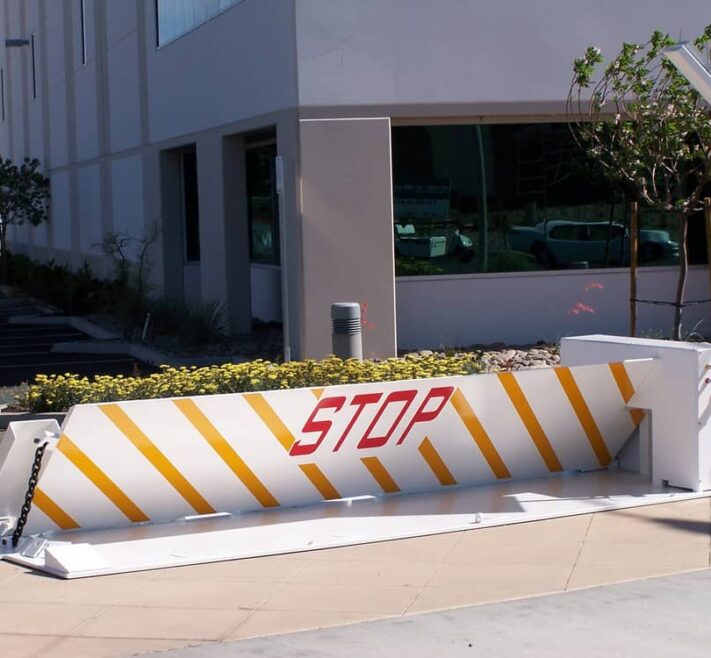
You can keep the specification brand-neutral and still position the project for proven product categories. For example, when a project needs a crash-rated portable barrier for temporary protection, a portable barrier category requirement aligns with solutions such as Delta’s MP100 and MP5000. When a project needs permanent protection at a controlled entry point, a crash-rated gate, wedge, beam, or fixed bollard requirement aligns with Delta’s fixed barrier families.
Conclusion
Good barrier specs are specific about performance and flexible about manufacturers. If you define crash rating and penetration, then add cycle time, duty cycle, and environmental conditions, you will get cleaner bids and fewer surprises in the field.
Next step: If you want a quick spec review for rating language, penetration, or duty cycle assumptions, share your drawings and basis of design with Delta. Contact Delta Scientific to start a technical review.
Recent Posts



Frequently Asked Questions
Delta Scientific
Delta Scientific Corporation is the world’s leading manufacturer of vehicle access control equipment. Delta Scientific has been engineering and manufacturing vehicle access control equipment and selling its products worldwide since 1974.